











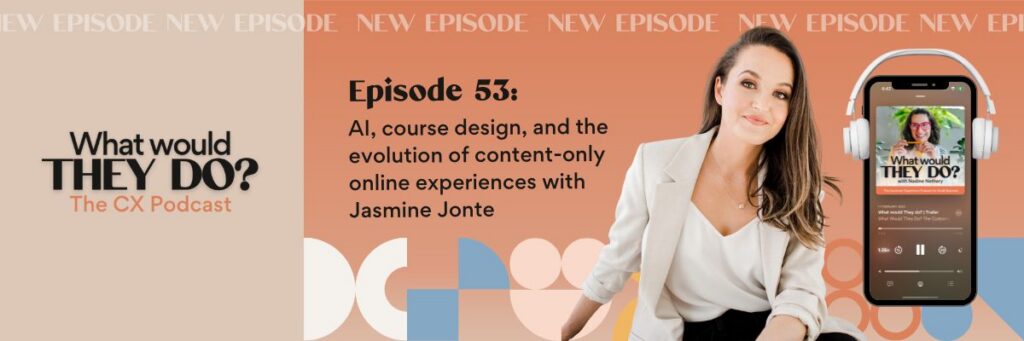
EPISODE 53 OF WHAT WOULD THEY DO? THE CUSTOMER EXPERIENCE PODCAST FOR SMALL BUSINESS OWNERS
NOTE: Some of the tools and resources mentioned in these shownotes could be affiliate links. That means when you click the link to create an account, start a free trial or make a purchase, it won’t cost you any more but I may receive a commission for introducing you. One thing I want to stress is that I would never recommend anything or anyone I haven’t successfully worked with myself or trust unconditionally.
What makes an online course truly transformational instead of just another addition to your digital filing cabinet of information?
In this guest episode of What Would They Do?, I am joined by course design expert Jasmine Jonte, who has helped build some of the most successful and profitable online programs in the industry.
Together, we unpack why so many online courses fall flat, why students drop off halfway through, and what course creators need to focus on if they want their programs to actually deliver results in the age of AI.
Spoiler: it’s not about adding more modules, more bonuses, or more “value.”
It’s about designing a student experience that supports action, accountability, and momentum.
If you’ve ever wondered why people buy your course with excitement and then disappear by Module 3, this episode is for you.
What we cover:
The biggest misconception course creators have about engagement
How to create simple learning tracks so every student feels supported
How accountability loops improve student follow-through
How AI is reshaping the online course industry
Why Amy Porterfield closing her course doesn’t mean courses are dead
Soundbites:
Jasmine Jonte: “Your students are not there to learn. Consumers are no longer believing that information is powerful. They know they have to take action to get that transformation, which is what they’re here for.”
Jasmine Jonte: “Your students don’t really care about you. They know you, they like you, they trust you, they believe that they can get a result with you, but they don’t really care about you. They care about the result. We just have to give them what they need right now.”
More about my guest, Jasmine Jonte:
Jasmine Jonte is the founder and CEO of CRE8TION, where she helps top experts turn their knowledge into transformational, revenue-generating programs. Jasmine and her team ghostwrite courses end-to-end, from scripts and slides to workbooks and portals, so clients can stay in their zone of genius. Over six years, she has produced 120 programs and 1,500 lessons for 100,000+ students, generating millions in revenue for industry leaders.
Website: www.cre8tion.co
Youtube: https://www.youtube.com/@JasmineJonteCRE8TION
CustomGPT: https://www.cre8tion.co/netflix
😍 Love the show?
Submit your question so I can answer it in an upcoming episode (or invite the perfect guest expert!).
Post a screenshot with your key takeaway on your IG story and tag me @candocontent and #WWTDpod so I can repost your content.
Your next steps:
Find out how you can get my strategic customer experience brain on your brand here.
Grab the FREE State of the Customer online business industry report with first-hand findings, gaps & opportunities PLUS proven strategies to boost your customer experience. Download FREE here!
Join the Retention Lab, the membership for savvy online business owners determined to grow their revenue, referrals and repeat business without more marketing. Join here!
Check out my favourite CX tools and resources here.
Episode Transcript:
Nadine Nethery (00:01)
Hello, hello and welcome back to the podcast. This is officially the first guest episode of 2026, which is exciting because I love having a good chat with great people who share amazing things. So today’s listener question is one that I haven’t received just once, but multiple times. So I’m super excited to dive into today’s question.
what makes a course truly transformational rather than just informative. And to be honest, as a course creator myself, it’s always good to know how you can support your people and really set them up for success right from the get go. So to answer today’s question, I have invited Jasmine Jonte who I just worked out is a fellow mixer minder. There’s so many of us, all amazing people.
Jasmine is a course whisperer behind some of the most successful and profitable online programs out there. Jasmine and her team transform your expertise into binge worthy results driven learning experiences. And Jasmine knows exactly what makes a course click and stick and what makes students rave about the results they’re getting from your course. So welcome to the show, Jasmine.
Jasmine Jonte (01:17)
Thank you for having me. I’ve never gotten like course whisper before, but I really, I’ve gotten course doula many times. ⁓ but I like whisper. It’s a little gentler. So.
Nadine Nethery (01:21)
Yes, yes, doula, it just brings back those birthing memories. I’m like, let’s just skip straight past that, right? So let’s go with a course whisperer. Sounds magical, sounds transformational, which is what people sign up for when they buy into a course, right? So why don’t you start with a little self-introduction? I always feel that works much better than bios. So let us know what you do and how you got to where you are today.
Jasmine Jonte (01:57)
For sure. Thanks. Yeah. So I have an agency that supports experts in productizing what they know. So every expert, have, they reach a point where they’re booked out. Like they’re fully booked out. They’re sold out. They’re trading time for money. They’re renting their brain by the hour. They’re renting their skillset by the hour. And now the question is, how do I decouple my income and my impact from my time?
And in order to do that, there’s a whole host of things that you need to know and become in order to achieve that result. So that’s really what we aim to do. And what we do do with our clients is we take all the information that’s in their brain, develop leveraged offers that allow them to decouple time from income and impact. And then we build out those offers and the marketing plans for those offers so that they can reach that new level for themselves and their business.
Nadine Nethery (02:57)
Awesome, that sounds so, so tempting as a mum of three who wears far too many hats. I’m like, my God, imagine handing what’s going on up here over to someone who makes sense of it, designs it beautifully, packages it all up. my God, yes. How did you fall into course design?
Jasmine Jonte (03:00)
Yes, my background is in education and I taught here in the States in Detroit, Michigan in the lowest performing school in the country. So I became very good at making learning simple, easy, and fun to do and engaging students that otherwise might not want to be engaged or be as easily engaged. But that was a tough environment for me, as like any teacher would tell you, it’s a tough environment to be in. And so about, you know, four years in the classroom, I decided I needed to make a pivot and went into like the online coaching consulting kind of space. spent like four years figuring out up from down. Like I didn’t know anything about business at all. And so I, you know, I earned my stripes or whatever the saying is, I put in the reps and I was just really good at getting people results. You know, like I had great LTV, I had great retention, crazy testimonials, but I couldn’t really crack the marketing thing. And it’s course I had literally no background in it. So I bought a course on how to market your online business. It was $7,500. I logged in and it was terrible. I mean, like it was so bad. And
I couldn’t believe that this guy’s posting on the internet about how he makes millions of dollars every year on a terrible program. But it was like this light bulb for me because I recognized just because someone knows what they know, like clearly he’s good at marketing and sales if he’s selling $7,500 programs, right? Just because they know what they know doesn’t mean they can teach what they know. But I knew that.
And so then I was like, maybe I should just like work with these other people and help these experts who have a really great, you know, knowledge base help others transform with that. And so, yeah, so that’s how I got into what we do now. And it’s been six years that I’ve been doing that for other people, like building programs for other people. And yeah, now it’s a full blown agency, not just me and a couple of VA’s. So pretty cool.
Nadine Nethery (05:20)
Well, there’s so much demand, isn’t there? The online space has exploded and I feel like the focus is much more on actually delivering transformation rather than just the sell Right? And I feel like sometimes with the gurus, the big people out there, it’s all about the cell and then what comes after is often forgotten. So let’s fix that in this episode and give people some pointers
how they could get started in their own, course design journey. So as a former teacher, respect to begin with, my husband’s family, they’re all teachers. I reckon my daughter’s got the teacher gene, she’s 14, set on becoming a teacher and she’s got that innate empathy and patience, so total respect. But I reckon you’ve got a total unfair advantage, you know, in inverted commas, because working in an underperforming school engaging those kids would have taught you so many valuable lessons in engaging kids, which then obviously translates into adult learning as well.
So as someone who has worked in an underperforming school, had to be somewhat creative to engage the students, is there something that now has become sort of intuitive for you that course creators generally forget about when it comes to designing their course content?
Jasmine Jonte (06:44)
There’s many things. There are many things. One thing I will share is that when I had my kids, I taught kindergarten, okay? And when I had kids coming into kindergarten, some of them could read. Like they could fully read on maybe even a first grade level. So they’re like ahead. And then I have some kids who can know their letters and sounds and they might be able to put a few words together. And I had some cuts come in who didn’t know a single letter.
So even though they’re all in the same grade or the same program, the same class, the same cohort, they’re all in a completely different place. We all have to learn reading, but we need to approach it a different way. So this often happens with online programs, as you assume because you have an ideal client, they’re all gonna be on the same level and it’s just not true. And without having to…
differentiate and build three different programs, one for your beginner, intermediate, and advanced, there’s some simple ways to make them feel seen and understood so that they can move through the program in the way that works best for where they’re coming to it from. So simple learning tracks. If you’re this kind of person, start here. If you’re that kind of person, skip this step.
It really is dependent on the program and what the outcome is. I can’t give very, very specific recommendations, but giving your students the opportunity to choose their own adventure in a way, how it gives them command over it and helps them see that no matter where they’re coming from, there’s a place for them to start. So that’s like a very simple one, but often I find most people aren’t thinking about
Nadine Nethery (08:28)
Hmm, seems like such an easy fix, same content, but just pointing people in the right direction and setting them up for success and quick wins, which keeps us motivated, right? We need that little dopamine hit of going, oh my God, I just ticked this off. I just achieved something. So good. So good. You’ve worked behind the scenes on hundreds of courses, so many lessons and courses that also supported thousands of students. So I suspect you’ve seen a lot of things that actually work, a lot of things that don’t work. And you’ve worked out what goes beyond something that sounds great on a sales page and gets the sale, right? So based on your experience, what’s the biggest misconception course
creators have about why their courses might be falling flat. Like is there something that they assume and you go, no, no, actually you’re totally, totally on the wrong track.
Jasmine Jonte (09:21)
Yes, the biggest misconception people have is assuming that their students are there to learn. Your students are not there to learn. They don’t want to learn. They want a result. Like that’s why anybody buys anything is because they want a result. so over indexing on content is a huge mistake. Like done are the days where the bundle of my seven course bundle is powerful. Like no one, and especially with the sophistication of the market on the rise in the last couple of years, the consumers, they’re not believing the idea that information is powerful. They know they have to take action to get that transformation, which is what they’re here for is the result. So I think, and alongside that is actually goes back to marketing and sales is like, you’re marketing and selling them to buy the program, but you have to keep selling them into the idea of why they should take it and why they should finish it and why they should do it. So things like case studies and testimonials, right? We’ve all been told social proof. That’s how you get someone to buy your program. Great. Well, are you using that social proof in your actual content as well to help them remember why they should keep at it when things get hard? We all run ads to get people on our list to then market and sell to them. But have you ever considered running an ad to the people who’ve already bought your program, not to get them to buy the next thing, but to remind them that they should log in and take it? Like it’s simple things like that. It’s the same mechanism. It’s marketing and sales and persuasion, but instead of persuading them,
opt in or buy, you’re now persuading them to invest their time in themselves and come back to the thing they already decided they want to do, but maybe fell off because life got hard. ⁓ Yeah. That’s, think, the biggest misconception of all the misconceptions.
Nadine Nethery (11:15)
That is so clever, running ads with case studies and results. Because we all buy things with the best intentions and then forget why we actually bought into it. To be honest, in the early days of my business, which, God, I’ve been in business almost nine years now. So way back when, you know, the online course space was booming, bundles were everywhere. I have a whole collection of courses and things that I never looked at. Signed up.
with the best intention of doing stuff and never got to it or I started and then fell off. So what I’m taking away here is less is more. So really focusing on the things people need to get results rather than the fluff that often comes around it. And stepping away from leading with the learning. You’re gonna learn to do this on the sales page, which as a former copywriter, I’ve always told my clients, don’t lead with learning, you’ll learn to do this. Like lead with the transformation. At the end of this course, you will have achieved X, Y, Z. So loved hearing that, you’re on the same page here. Results and transformation and action is so much more important than learning because no one wants to go back to school. Let’s face it.
Jasmine Jonte (12:26)
No, even those of us who liked school don’t, I don’t really want to go back to school. ⁓
Nadine Nethery (12:28)
Yes. Yes, we’ve all done the courses, we’ve all done school, but I’m glad it’s finished. I’m glad I don’t have to do exams and all the things anymore. so we’ve already established that students drop off because they feel overwhelmed potentially with all the content. What else, makes people drop off and
Jasmine Jonte (12:35)
Yeah.
Nadine Nethery (12:52)
stop halfway through a course. Are there other obstacles, other issues that can pop up in course content and course design that stands between students actually getting the results, finishing and having that transformation?
Jasmine Jonte (12:54)
I’ll start at the beginning. Onboarding can set real unrealistic expectations. So it’s really like pacing your students, especially onboarding is really important to say, this is a six week program. You’re going to get one module a week. It’s going to drop at this time. Why don’t you put some time in your calendar right now to log in an hour on Fridays. I’m making something up here, right? To get in. And there’s going to be additional time. So you probably want to block like actually tell them how much time they’re going to need. And if you don’t know, give it your best effort. and then give them options, slow, medium, fast track. So all the way at the onboarding, we’re telling them what to expect over time rather than just being like, all drop off at module three. What happened? Well, maybe they thought they would be done by that time and now they’re frustrated and they’re over it because they didn’t actually know what it was going to take at the beginning. So I think realistic expectations at onboarding is really, important. And then another piece of this is accountability loops, especially if you have any kind of hybrid programming where there’s either one-on-one calls with you, group calls, peer calls, community, et cetera. It’s like, what’s your mechanism to actually hold people accountable if they’re not showing up to the group calls? Are you reaching out to them?
If they are showing up to the group calls, are you having them declare an action step that you’re following up with them on next week? I feel like we have these hybrid support structures, I call them, like support options. And then it’s just a blanket Q &A, which Q &As are powerful when you have a really good question to ask and when you can make the call time. But otherwise, Like I think we’re past the point of people seeing Q &As is super valuable. So really facilitating an experience rather than just, hey, I’m here if you got questions. You know what I’m saying? Which might be hard for some people to hear and I hope you’re just receiving this as intended, which is that small little tweak. You literally don’t have to change anything. You’re just changing like the name of a call, the structure of the call, the amount of support you provide before and after, like directly before and after the call can really change the way people show up and if they show up to your calls, So like just a couple things there, but one other thing I will share. So we talked about onboarding realistic expectations. We talked about support structures actually being supportive. Another reason I find people drop off is because we are not, seeding the idea that they’re going to.
Nadine Nethery (15:25)
Yeah, absolutely.
Jasmine Jonte (15:48)
If you look at any kind of habit research, it’s kind of normal to like fall off track. They should expect to fall off track. And if you lead with that at the beginning so that they already know, okay, when I fall off track in the future, here’s how I’m going to respond to it. Here’s how I should think about the fact that I fell off track, which if I fall off track, all it means is that I’m on track. Did you see what I was saying?
If you tell them how to respond when it happens, then they’re not left in their four corners of their office with a bunch of resistance, feeling like a failure because they fell off track. Right? So I think it’s interesting because a lot of people say, they fell off. But all of that work I just mentioned is all prep work. You can pivot, yeah, but you’ve really got to intentionally design it from the front end, expecting it’s going to happen.
Nadine Nethery (16:25)
I love that. for me, the penny drops while I’m talking to you. It’s again, just putting, you know, starting with your customer and seeing what they need to be successful rather than starting with your content and your ideas and what you want to communicate. So setting them up for success by flipping that coin, right? how can I make it accessible? I know it’s like that in business.
Jasmine Jonte (17:00)
spoiler alert, your students, don’t really care about you. They know you, they like you, they trust you, they believe that they can get a result with you, but they don’t really care about you. They care about the result. So many of my clients want to put in an about me section of their course to edify them and showcase their expertise and all the things that they’ve done. And every time I have to be like, I’m sorry, your ego needs to die a little bit today because they don’t actually care at this point. Like they’ve already said yes, bro. Like we just have to move them through to what they need right now.
Nadine Nethery (17:32)
Yeah, they’ve invested, they clearly are on board with what you’re about to teach. Let’s just move straight to the good bits.
Jasmine Jonte (17:40)
Exactly. Yeah.
Nadine Nethery (17:41)
What else I loved about your take here is thinking outside of the box. So stepping away from things that might have worked in 2023 when Q &A sessions were a thing. I feel like we need to be more creative, more flexible nowadays to work with busy schedules, again, time zones here, like we’re catching up completely opposite sides of the day. So for me personally, making any live call, any live Q &A session in US time is somewhat totally unachievable because kids are waking up, kids need to go on the school bus.
So for me, that would be a total no go. I’m a huge fan of different formats of accessing someone’s support, in my membership in Retention Lab, for example. I have very minimal live calls because I know we’re all over the world. I’ve got people in Europe, the US, here in Australia. It’s impossible to support everyone. So in the incubator tier, people can vox me when it’s with them and I get back to you then.
when it suits me. So it works for everyone and slots into their busy lifestyles. What’s your take on, you know, support format, like private podcasts? I know there’s so many options nowadays. Have you got any favorites where you go? They’re totally underrated, but I think they should be part of any course.
Jasmine Jonte (19:01)
I mean, I love a private podcast feed. do, especially because if the student is like you’re describing, like a busy mom or a busy business owner, it’s just so easy for them to slip into their day-to-day process. know, like I listened to your podcast while I was putting on my makeup this morning, right? Like it just makes life easier if it’s a private podcast feed. I think that the question to ask is exactly that though. It’s like, who’s your ideal client? Because we’ve done programs with like Gen Z who they want QR codes that go to TikToks. Okay. And then we’ve done programs with people in their seventies and eighties when given the option to either receive an online program, a DVD or both chose the DVD only option. Okay.
So it’s all, it always comes back to like, who’s your ideal client? What’s their life look like? And how can you just make it easy for them to plug in? Which is why like the AI tools are so powerful right now is because they allow personalization at scale. They’re a quick implementation tool. You can’t build a good AI tool without a good curriculum. So it’s also like, you have to, it’s another little nice.
piece to the offer stack that shows that you know your stuff, because if the AI tool is good, that means your curriculum is good. ⁓ So anywho, again, that’s something I would say. Every program should be considering how they’re going to leverage AI, whether that’s in the curriculum, a GPT, a coach clone, or even AI automated backend features that support the student experience, even though it’s not an AI tool that the student is actively using that makes sense, like an internal tool that supports the experience. So yeah, there’s like a lot to say about that. So much so I feel like I’m rambling and forgot the question, but I hope that’s okay.
Nadine Nethery (20:40)
No, no, you did. You did great. It all comes back again to know your customer, know the format, it’s a matter of finding out what works. How do you just out of curiosity, what’s the process on the backend when you design course experiences, to actually find out.
Jasmine Jonte (20:56)
Yes.
Nadine Nethery (21:07)
what works for the audience. you run surveys? Do you rely on your client’s research and data or do you take care of that as well?
Jasmine Jonte (21:16)
definitely if there’s already a program in place or their audience is in a first program, we’re building the second, whatever that looks like. We install surveys. Our first survey actually happens at the end of the first module. I think a lot of people make the mistake of waiting until the end to get a testimonial survey when some of the best people I know in the industry have never hit more than 85 % completion. Okay. Like my best completion rate when I was actually teaching myself was like 82 between 82 and 85. So even at that, you’re not hitting a hundred percent of the people, but you can get a lot closer to a hundred at the end of module one. So we want to get their feedback as soon as we can. so that’s one. And then we usually do one about midway and one toward the end. And We run those surveys across all the different aspects of the program. So not just the curriculum, but the student experience, the UX, the, you know, are they excited to continue? Yes, testimonials, just gathering all of that data. NPS, we use Net Promoter Score in every program we build. So we definitely do that. And then we also try to keep that as like the main source of truth and we push to those links. So for instance, we also send emails out about those surveys. So if they didn’t see the survey embedded in the curriculum, they’re also getting a touch point that way. We’re also talking about those surveys on live calls where it’s like, hey, you, know, or about that time in the cohort, if you didn’t complete this, do it now. And even if you’re running like an evergreen, like you have like retention lab is evergreen, you can still every like once a quarter run a survey or remind them on, in a Vox, right? Like, here’s like, please let me know how things are going. So I think that’s just having like one main source of truth is really, really helpful.
Nadine Nethery (23:03)
So I am, I’m a huge fan of gathering feedback. So I have surveys as well at, you know, certain times. And what I feel in the online space is often tempting is to just, you know, file them for later, like testimonials, but
ignore the actual gems and goodness people give you because as you said I’m asking you know is there one thing I can do better like what would you love to see in the course or in the membership and while it can be and somewhat
upsetting sometimes. there are so many easy things that I’ve been able to fix that have made the experience so much better and it means people are getting results, people are taking action, it’s easy for them to just jump in and tick off a task that I had in mind for them this month. So actually looking at what people are telling you and the signals they’re sending you is just so important. my god, I love all this.
I know you touched on AI and I totally agree. we can’t hide it’s happening. It’s got its good parts, bad parts. But what’s your take on AI and how it’s going to impact the course space? we’ve seen Amy Porterfield close her course, which some people, take as the sign of doom and gloom and the course industry coming to a complete standstill, which I don’t necessarily think is true, but AI definitely is impacting course creators and sales results So what is your take on AI, courses and the future?
Jasmine Jonte (24:29)
So much to say, so much to say. So, okay, so thing one is in order to do AI well, you need to have good curriculum and frameworks and a body of work. And in order to have a good body of work and frameworks and curriculum, you have to actually be an expert in something. So this is great news for people who are listening because chances are if they’re listening to your show, They actually do have an expertise and they can build a really good curriculum, which will allow them to build really great AI implementation tools, et cetera. So that’s one side is like, how is AI playing into the programs that we build and the things that we offer? What’s also great is we now have another like category of offer. Three years ago, was like there’s self-paced courses, there’s group programs and there’s memberships. Now you can literally, and if you look at some of the really big players in the expert space across different niches, they’re selling just their coach clone, just access to their coach clone, and it’s added an entirely new revenue stream to their business. So this is a huge opportunity for us on the business side of things. So that’s thing one. Thing two is how are we using it internally? And you’ve probably heard garbage in, garbage out, right? And it’s the same thing here. People are afraid, my gosh, it’s gonna be so much easier for other people to make a course in my niche. But the truth is, if they’re just going to chat GPT and not leveraging their own expertise, that means that their course and what they’re putting out there is gonna be trained on the internet. I don’t know about you, but I don’t want a course in any kind of niche expertise that is trained on the internet because most of it is inaccurate. So, you know, this is another thing. Like if you’re a true expert, this is good news for you because not right now, but in the near future, the cream is rising to the top. And if you don’t have the goods to back up what you’re doing, it’s not gonna work. So I feel like we’re kind of in the middle of a crunchy area. And if you’re a true expert, things will turn around. And then, okay. Finally thing around the Amy Porterfield situation, and I shouldn’t laugh because I understand people really are like, this is really scary to them, especially if they really look up to her. You have to consider what Amy Porterfield’s niche is. She has been Digital Course Academy. She has been the girl that has been selling that courses are the answer. And now the market sophistication has realized courses are not the answer. Her entire business was built on this one belief that now it’s really hard to get people to believe, especially with AI. So just because the course girl is struggling with courses doesn’t mean that courses in your niche won’t work because you are trying to solve a different problem than she was trying to solve. Does that make sense?
Nadine Nethery (27:23)
Absolutely. And again, it’s about evolving, moving with the space, acknowledging AI is coming. So I don’t think we can keep pushing stock standard courses that sold on Evergreen without problem years ago. And as you said, people who don’t have the goods to back up what they’re selling, what they’re teaching you will quickly be exposed because they’re not getting you the results. Things just aren’t working. And I feel like it’s gonna clean up the industry personally. Talking about results and moving with the times and really focusing on your customer and your student, what is your take on the long-term impact of
course design and learning design on your business in the long run. Have you seen results from your customers that you can potentially share with us or generally, like what’s happened to their businesses once they’ve focused on actual outcomes and transformation?
Jasmine Jonte (28:33)
Good things, very good things. It’s something that affects the whole business. Like I have seen oftentimes when someone has a program and they know it’s good, they actually struggle to sell it because they don’t think the program is as good as they are ⁓ versus the clients. Like I’m thinking of one client, corporate guy, he did culture at Zappos and he built a program about culture. And I remember us delivering the assets to him, like his slides and the scripts and all the things. And he was like, dang, I feel like this is actually better than just me going into a company and doing culture. And like, that’s now really powerful because now he has the conviction when he’s trying to sell and market this program. He feels like it’s even better than him one-on-one. So I feel like that’s a big. part of it. Everyone says, like the LTV. And yes, I could point to numbers and facts and figures. And that’s, feel like the internal shift is something every business owner that’s really truly heart centered and cares about getting people results can connect with. Because we all know what it’s like trying to sell something and you don’t know if it’s going to work.
Nadine Nethery (29:41)
I love that the confidence that comes with having a bloody good excuse the Aussie slang bloody good program.
Jasmine Jonte (29:51)
No, you’re absolutely right. Yes. Yes.
Nadine Nethery (29:56)
It’s the best feeling, If you know your students, like people who invest in you, in your products, in your brand actually are seeing a transformation and they’re thriving, makes you feel good, makes them feel good. I feel like that’s why we’re in the business space. Me anyway, I love supporting people. I’m a people person. So I’d hate to know that people are spending money and not getting results.
So yeah, listeners, make sure you take a closer look at your programs, at your courses, and check out how amazing they are and potentially make some tweaks, which brings me to my next question. If you had to give listeners one piece of advice that they can take away from this episode. Where should they start when it comes to their courses to make the course experience even better?
Jasmine Jonte (30:41)
My number one suggestion would be spend time in offer design especially with Chat GPT, I think a lot of people are going out there and just like, give me an offer, any offer, you know, what do you think? And like I’m thinking about, I just got this stat back yesterday. So Hot Off the presses it’s one of my bigger clients. They’ve been in this space for 15 years and we just learned that 85 % of the students who went through their certification program, we did graduation in December, 85 % of them actually got certified, which was, it was a rigorous certification. It was like not an easy, you know, take some quizzes certification. Okay. Like they had to like prove that they could be a transformational coach in many different ways. And, I think that that program worked so well because we spent a long time, like thoroughly cultivating the offer every element of the offer, the vision for every element of the offer, mapping out exactly how it was going to work. mean, and I should also mention this was a high ticket investment and they have never done a high ticket program before. Like they have chronic kind of low take, they have like a $33 membership and it’s, they’re in a niche where people, it’s really hard to get people. They’re in the spiritual niche, which if you know anything about spiritual niche, the adage goes, ifA business owner would pay 100 bucks, you need to sell it for like 50. Like whatever typically you would sell a B2B program for, you cut it by half and maybe a spiritual person will buy it, like in the spiritual niche. So all that to say is spend more time than you think you need to in offer design because then you’ll really know what it is you’re putting out there and how you need to fulfill on it. Yeah.
Nadine Nethery (32:14)
And I feel like even taking that step back. So designing your offer based on firsthand research, like talk to the people, find out what actually moves the needle for them, what they need, what they can do without the formats they love. So really get to know your people, design the offer, design the course experience. But yeah, taking steps back, I feel, is the theme that pops up on the show with customer experience in general. Like don’t work based on your assumptions and what you want to put out there backtrack and flip that coin over to your customer. I feel like we could talk for hours, Jasmine. I got so many awesome takeaways, ideas. I definitely need to go back and have a look at some of my courses that have been sitting there for a little while. They’re definitely due for an update, but yeah. So many pointers, hopefully you’ve taken some notes and have some ideas to transform your cost experience as well. So one question I ask all my guests is this one, what is one burning customer experience question that you have specifically to your business?
Jasmine Jonte (33:39)
So I have an agency, okay, and it’s very interesting because I can do, you know, we do customer journey work. I can do one-on-one customer journey work and client experience work and course design like all day. But agency customer experience is like, it’s different. It’s the similar, but it’s different. And one of the questions that I’m currently working through right now is how to successfully design their first experience in a way that seeds the ongoing work. So in a way that seeds like a backend offer. So when they get to the end of, for us, usually the first engagement, like we build a program or we design a membership or whatever it is, we do that first big project, we get to the end of that and they’re not like, so I’m still questioning if I should continue. It’s like, okay, here’s what we’re doing next. When can we get started? So that’s what. That’s what I’m thinking about right now, especially with LTV in play.
Nadine Nethery (34:36)
Yes, but I love that you’re thinking about it because a lot of people just go, project by project. So, so smart.
But yeah, complex, right? Seeding things, again, knowing what they need to hear. So they’re ready when it comes to that pointy end. So many moving pieces. Great question. Awesome. I want to thank you for coming on the show, Jasmine. I had so much fun chatting to you and I would love our listeners to be able to connect with you. So where can they check you out online? Where can they connect and stay in your orbit?
Jasmine Jonte (35:09)
So I’m a YouTube girly. I post every week over there. So you can definitely check out the YouTube. And then I also have a custom GPT called 10 Next Level Strategies to Make Your Course or Program as Benchworthy as Netflix. So if you go to creation.co.netflix, it’ll take you through like a Cosmo Girl style quiz.
Nadine Nethery (35:27)
Love it!
Jasmine Jonte (35:34)
And it’ll give you a personalized, customized suggestion with case study examples for how you can improve your course experience. So that might be super helpful. Yeah.
Nadine Nethery (35:42)
So cool. Amazing. So make sure you hit up that custom GPT You check out Jasmine’s YouTube. You hit subscribe on this show if you haven’t done so yet. yeah, thank you so much for tuning in this week and I will be back in your AirPods next week.
Jasmine Jonte (36:00)
Thanks for having me.