










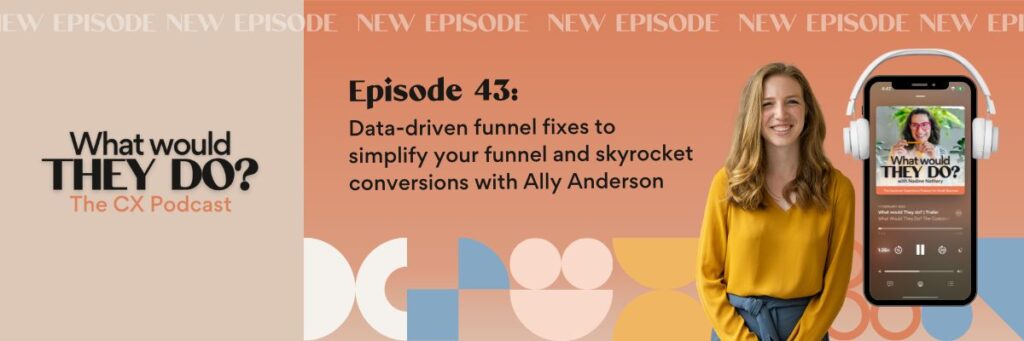
EPISODE 43 OF WHAT WOULD THEY DO? THE CUSTOMER EXPERIENCE PODCAST FOR SMALL BUSINESS OWNERS
NOTE: Some of the tools and resources mentioned in these shownotes could be affiliate links. That means when you click the link to create an account, start a free trial or make a purchase, it won’t cost you any more but I may receive a commission for introducing you. One thing I want to stress is that I would never recommend anything or anyone I haven’t successfully worked with myself or trust unconditionally.
In this episode, I’m joined by data strategist and Akari Digital founder, Ally Anderson, to tackle a question that keeps many business owners awake at night:
“My funnel gets plenty of traffic, but no one is buying. Where do I start?”
This conversation picks up where episode 40 with copywriter Laura Kendrick left off. In that episode we explored conversion problems from an emotional and messaging perspective. Today, we zoom in on the data side, and how to pinpoint and fix bottlenecks strategically so your funnels convert more consistently.
If you’ve ever stared at your metrics wondering why your funnels aren’t converting, this conversation is your blueprint. Ally and I unpack how to diagnose bottlenecks, simplify your data, and use smart tracking to improve conversion rates without having to become a full-time analyst. We explore how customer experience and messaging intersect with metrics, and why simplifying your offers and funnel steps can dramatically improve results.
What we cover:
The Funnel Friction Audit
How to map your customer journey beyond open rates and click rates to uncover the real leaks in your funnel.
Simplifying Data Tracking
Why eight to twelve core metrics (not 87 dashboards) will tell you everything you need to know.
Spotting and Fixing Bottlenecks
Simple ways to calculate where prospects drop off, and how to prioritise your tests for the biggest impact.
Customer Experience Meets Metrics
How friction, confusion or lack of clarity kills conversions, and easy fixes you can apply today.
Less Is More: Designing Offers for Action
Why breaking big promises into smaller wins can boost opt-ins, completions and sales.
Real-Life Tweaks, Real Results
Ally shares examples of tiny homepage and opt-in tweaks that doubled and tripled conversions overnight.
Soundbites:
Ally Anderson: “If we’re almost thinking like a Maslow’s hierarchy of needs, there’s like the hierarchy of data needs. And so the most foundational level of data is understanding your overall customer journey. Usually any business we can pick eight to 12 metrics that can tell that entire story. And that’s kind of our essential level of data. And honestly, open rates and click rates have nothing to do with any of that.”
Ally Anderson: “In the group program and the course space, there’s a lot of talk about let’s get people into them and let’s sell people. And there’s not a lot of talk of how do we get them to actually do the thing? The stat for completion rate in the course industry is something ridiculous, like 15 or 20 % that I think is abysmal. Why are we holding ourselves to that?”
More about my guest, Ally Anderson:
Ally is a data-backed marketing strategist who helps small business owners put their time, energy, and money in the right places when it comes to their marketing. After a decade in digital marketing, she’s watched countless business owners throw marketing spaghetti at the wall, hoping something sticks— simply because they don’t know how to track their results. She shows them how to make sense of their marketing data in simple, practical ways, so they can invest in what works and stop wasting resources on what doesn’t.
Website: https://akaridigital.ca/
Instagram: https://www.instagram.com/akaridigital/
Grab Ally’s Launch Leak Finder tool for only $7 with coupon code NADINE to help you pinpoint your funnel’s bottlenecks and test potential improvements without the overwhelm.
😍 Love the show?
Submit your question so I can answer it in an upcoming episode (or invite the perfect guest expert!).
Post a screenshot with your key takeaway on your IG story and tag me @candocontent and #WWTDpod so I can repost your content.
Your next steps:
Find out how you can get my strategic customer experience brain on your brand here.
Grab the FREE State of the Customer online business industry report with first-hand findings, gaps & opportunities PLUS proven strategies to boost your customer experience. Download FREE here!
Join the Retention Lab, the membership for savvy online business owners determined to grow their revenue, referrals and repeat business without more marketing. Join here!
Check out my favourite CX tools and resources here.
Episode Transcript:
Nadine Nethery (00:00)
Hello, hello and welcome back to the podcast. Super excited to dive into one of my favorite nerdy things this week, data and funnels and the combination of the two. So today’s question we are going to look at is, my funnel gets plenty of traffic, but no one is buying. And today’s episode is going to pick up where we left off in episode 40, where I had copywriter Laura Kendrick on the show.
If you haven’t listened yet, make sure you queue it up straight after this episode. We looked at conversion problems during a launch from an emotional perspective and within the greater marketing arc, as Laura likes to call it, and today we are going to come at a very similar problem and question from a somewhat more data-driven perspective.
I’ve invited the amazing Ally Anderson to walk us through real world strategies to diagnose conversion issues strategically. She has a background in data analytics, user experience, SEO and systems, all the things a lot of us dread and is the founder of Akari Digital. Welcome to the show, Ally.
Ally Anderson (01:11)
Thank you so much for having me. I’m so excited to dive into this with you.
Nadine Nethery (01:15)
We were chatting before hitting record how much of a data nerd both of us are and how good data is. Obviously I’m not nearly as cluey when it comes to data as Ally, but if you listen to the show, you know that I love data to make educated decisions in my business and for my client projects as well. So before we dive in, why don’t you give people an idea ⁓ who you are.
what you do, how people can work with you and how you got to where you are today.
Ally Anderson (01:46)
Totally. Yeah, so what I do is I help people make smart informed decisions around their marketing. So maybe that’s around, should I invest in SEO or Pinterest, or should I optimize this thing? And I help people track and measure what’s going on in their marketing so that they can make those decisions with conviction and knowing that this is the right call.
And so I help businesses. I do work one-to-one in like done for you builds as well as I have a program called data backed entrepreneur Where if somebody wants to come and learn how to set this up inside their own business They can then do it in this done with you environment where they still get support to me But they’re the ones doing all the setup and the tracking
And yeah, I’ve been working in data analytics for over 10 years now, if I were to do the math. And it’s been a wild world in that it’s constantly evolving as so many marketing things are. And with like privacy settings and things changing over the years, it’s been a really fun puzzle to kind of stay on top of, but.
I love it and I love getting to then collaborate with experts like yourself when we’re working on marketing and we can kind of bring in all the different perspectives and kind of help make sense of it all.
Nadine Nethery (03:02)
Love it. my God, 10 years in data. You must have so much data, so many numbers floating around. my God. yeah, keeping on top of things, technology must be, must be tricky. Totally off topic here, but AI, has that impacted your work as well? So it hasn’t necessarily impacted and like helped make my life easier in terms of what I do, but what it has done unfortunately is it’s made
Ally Anderson (03:28)
People think that they can do more than they can because they think AI knows how to do the tech stuff for them. And like the number of chat GPT walked me through how to set up my Google Analytics. I’m like, and I can tell you without even looking that it’s wrong because it doesn’t know how this all works. And so that’s something like that’s more how it impacts right now. I’m sure I like have this dream to like build a custom GPT trained on how to actually set up some of these things so that we could use it that way.but that’ll maybe be a 2026 thing we’ll see. The shiny objects that we were talking about before.
Nadine Nethery (04:00)
all the shiny objects. my God. But yeah, it’s funny, isn’t it how AI can help us, seemingly speed things up and make things easier. But then there’s that lack of outside perspective, as you said, you think you’re doing it, you’re following chat, GPT’s advice and then boom, boom, it’s not actually converting or doing the right thing. But yeah, interesting. Let’s dive into this episode’s question. I feel, especially in my world, a lot of my members, when they join my membership, for example, they think they’re tracking data in their business and in their funnels. And often that looks like email click rates and email open rates. And that’s about where it ends. So I know you talk a lot about going beyond those surface level metrics and actually diving deeper. Can you unpack that for me?
Ally Anderson (04:54)
There’s different kind of levels of data. If we’re almost thinking like a Maslow’s hierarchy of needs, there’s like the like hierarchy of data needs. And so the most foundational level of data is understanding your overall customer journey. So from somebody finding out about you to the very first time, whether that’s on Pinterest or Instagram or ads or through a conversation, whatever that is, all the way through to them.
maybe coming to your website and being introduced to what you do through to them finding out about your offers on a sales page, a service page, funnel, whatever that looks like, to converting to then becoming a client. so mapping, usually any business we can pick eight to 12 metrics that can tell that entire story.
And that’s kind of our essential level of data. And honestly, open rates and click rates have nothing to do with any of that. And these are more important than those next level metrics. We want to just understand overall, how many people are we reaching? Are they liking what they’re seeing? Are they coming into your audience and connecting with you? Are they finding your offers and converting? Are they becoming clients and
sticking around or upselling or whatever it is we want them to do after they like work with you once or buy from you once. And that’s kind of our essential level of data that without any tracking tools, you can get most of that with Squarespace Analytics versus Google Analytics with like randomly counting the number of inquiries in your email inbox. Like you don’t need the crazy tools to pull those numbers, but those are the most foundational.
essential ones, then the next level would be what you’re kind of talking about of, okay, within email marketing, my open rates and my click rates can tell me if people are opening and clicking in my emails, but they’re still not telling you if somebody clicks in that email, they then go buy? Do they, if they land on the page and they don’t buy, did they scroll all the way down? And so that’s where we kind of build out the platform level metrics.
And then we can go even deeper into like microdiving beyond that. But I would kind of break it out in that way.
Nadine Nethery (07:09)
Yeah, that’s so cool. Do you do all that in one tool?
Ally Anderson (07:12)
Google Analytics will track everything on the website. In your email marketing platform, we might map UTMs, which is another crazy data thing that you may or may not know what they are. But like we map those things all into their individual tools, but then I like to bring them all into one place. So I set up dashboards in Looker Studio, which is Google’s dashboarding tool. And then we’ll connect that into your Google Analytics. We’ll get stuff zapped into Google Sheets so that it can pull your email marketing metrics over into there as well so that you don’t need to dive into 20 different places for all your data. We do want it all in one beautiful place.
Nadine Nethery (07:49)
Love the sound of that. Because as I said, I track my data, but it’s more disjointed and like more manual and UTM links. my God. I’m in love. Just knowing where the traffic on your website’s coming from, where your leads are coming from. It’s so insightful to work out whether collaborations are worth your time and effort. And whether something’s actually paying off because we can do all the things without having an idea of the actual impact on our businesses. love the sound of simplicity all in one place.
Ally Anderson (08:18)
Especially for folks who are already like hesitant or there’s friction around data, if you make, if you then need to click into 12 different places and like dig for stuff, that’s just another friction point. Make it in a pretty dashboard that’s in your brand colors that when you open it you get excited, like that’s the
Nadine Nethery (08:23)
So if someone doesn’t have, your fancy analytics set up, what would you say is one simple way for them to start identifying where those friction points might be in their funnel without getting lost in multiple systems and tools?
Ally Anderson (08:53)
The most important thing that you know is to figure out if you have a bottleneck or where that pinch point or bottleneck point is in your funnel. So a funnel is very linear, that we have step one that they saw on OptinPage for some freebie or thing. Step two, they signed up for that thing. Step three, they did that thing that you wanted them to do, whether it’s download, watch, show up, like whatever.
where if you then like were to focus on this one little area, what can you improve that by 5 % or 1 % depending on where it is and being able to just identify those things. You don’t need fancy data tools in your email marketing platform. You’ll be able to see how many people filled out that form in your sales platform. You can go into ThriveCard and grab the purchases. You can just put those into a little spreadsheet, calculate the little percentages and that’ll give you so much clarity into where to focus.
Nadine Nethery (09:47)
And it’s intentionality, right? Like you can build all the funnels, throw spaghetti at the wall, not really knowing what works. Whereas if you take note of the numbers and keep track, so what I like to do in my business is set aside time with myself, you know, book a time in the diary to look into my various funnels, conversion rates, how they’ve changed potentially because our environment, society, the world, things change. So we need to adapt messaging sometimes as well. I love how simple you break it down because it doesn’t have to be complex. It’s just a matter of actually putting aside time to monitor what’s going on and make improvements. So all that time and effort is actually worth your while. Yeah.
Ally Anderson (10:27)
Exactly. And then you’re not going to waste time, like, tweaking a sales page when you’re like, the sales page actually converts well. It’s that people come to this opt-in page and they don’t opt in. Okay, like, let’s go, let’s not waste time on things that are actually already killing it, or potentially derail them if they’re already doing really well.
Nadine Nethery (10:38)
And if in doubt, go and ask them, send out a survey at key points of that funnel and ask them, why didn’t you buy? What stood between you and the purchase and that can actually answer the question for you as well. And then, help you make those tweaks in the funnel.
Ally Anderson (11:01)
I love sliding into people’s DMs with voice notes and just being like, hey. But it’s the best data that you’ll ever have is actually having a conversation or getting a response from somebody in their own words.
Nadine Nethery (11:05)
And you’d be surprised how much people actually want to help you. So Ally, when you’re optimizing a funnel for yourself or a client, how do you go about deciding what to test first and where to start?
Ally Anderson (11:28)
Yeah, so like we had said, so I would have already identified that this is the step that I want to optimize. So maybe it’s the opt-in rate. And I guess another important maybe point to chat about here is the question that I always get is, OK, cool, I have all these percentages. How do I know if it’s good or not? That’s often a question that comes up that I guess we probably need to address first. As always in these situations, it depends, the answer that nobody wants to hear, but unfortunately is the truth. The best benchmarks that you can look at are your own. So especially if you have multiple funnels and you can see of my three funnels, these ones have opt-in rates for my freebie at of 20 % and this one has 5%. Okay, that’s a pretty clear, I’m going to jump in on the one that’s at 5 % and I want to fix that opt-in rate then it’s, okay, which marketing tactics are supporting this? The opt-in page or the content that’s getting them there. Maybe it’s ads that’s getting them there. Maybe it’s organic content or conversations, but looking at how are we getting people there and what’s the content there? And then I love to break that one step in the journey into additional steps. So they arrive on the page, do they leave right away or do they stay for 10 seconds? Do they scroll at least 25 % and stay for at least 30 seconds. Do they see the little form or like they click the pop-up so that you can sign up? Like, do they actually do that thing and then do they actually convert? So it’s like a journey within a journey. And you can track that. I set up tracking for that in Google Analytics, but you can also use like a heat mapping tool to get a pretty good idea. And those are simple and easy to set up that like it’s not super complicated. And so then you get that journey within a journey because if you look at your opt-in page or your sales page and people are seeing the very top section and leaving immediately, that’s a very different problem to solve than they’re staying for 30 seconds seeing the offer but not signing up. And so then you’re able to kind of get a better idea of is this the messaging? Is it the…
like content that’s on it that it’s not persuasive enough and you can start to kind of deduce. And we’re still testing because we don’t necessarily know is it the words, is it the design? Like we have to test and play around with different things, but at least you’re narrowing the scope of all the things that you want to do.
Nadine Nethery (13:57)
It’s a funny world, isn’t it? Online business space and funnels. There’s so many moving pieces and it’s so hard to get to the bottom of the thing. And often it’s a combination, right? The messaging might be slightly off and the traffic it’s, yeah, complex. Does it happen often that you come across a funnel where the customer experience is what lets, the whole funnel down? Or is it often more the messaging side of things?
Ally Anderson (14:27)
I don’t know if I could say whether one is more than the other, but I will say, when I think of customer experience, confusing people or not giving people enough information is a huge issue in a lot of funnels that I look at. And that for me is like, if you don’t make it simple, easy, frictionless for somebody to sign up. Like those are often the easiest things for you to knock out if something isn’t converting. Then if that’s still not working, sure, we can look at messaging and we can test messaging in different ways. I like, it’s tough to say if one is more important than the other, but I would say customer experience is often neglected or like not thought of. And it can be one of the easiest ways just to get your conversions improvement.
Nadine Nethery (15:14)
I recently ran the state of the customer survey, a big survey of online business owners, both from a business owner perspective and a customer perspective. And the one thing that came up from the customer perspective is that they want clarity, as you said, being clear on what they’re actually buying into, what’s behind that buy now button.
and they want to have a frictionless experience. So make it easy for me to purchase. So it’s very interesting you’ve picked that up in your work with, clients as well. So listeners, if you work on one thing, definitely audit your funnel around complexities. Do you make it unnecessarily hard for people to A, check out and add that item to cart? And secondly, are you crystal clear on
what they’re getting, what’s behind of the button. Are you even including frequently asked questions? feel like anticipating what some of those friction points could be in the funnel ultimately makes it so much easier for people to have that confidence to invest.
Ally Anderson (16:18)
And we need to think beyond what we want as well, because this is a conversation that I have with lot of people where they’re like, well, I don’t want to replay. Like, I want to show up live and I’m not going to do this thing if I don’t show up live. I’m like, I would so much rather watch a replay on 2x speed and just like get that better. And so there are different learning styles and different things that different people want. And often we can design our offers or design our sales pages or whatever around how we want to consume that information, we need to remember that there are other people out there that want it in different ways and the best way for you to get those sales is to make sure that you’re speaking to all of
Nadine Nethery (16:47)
Absolutely. And giving choices as well. even when it comes to designing your offer, giving the choice to have asynchronous support, have a live component for those people who thrive on, being in a Zoom room with others, private podcast feed for replays. Like I’m a huge fan. My most free here, I don’t have time as much as I love the double speed replay. I’m like, I need to have it in my AirPods while doing other things. Starting with the customer is just.
so important when it comes to designing your offer, but also then setting up the funnel to guide different learning styles and buyer types to that decision making process. As much as data helps you understand customer experience and the lack thereof is often, such an easy fix to, tighten that funnel and increase conversion rates.
All right, if you suspect that, the offer is great, the funnel does its job, but somehow the audience is not in the right mindset to make that purchase, do you have advice for listeners, how they can potentially meet those people where they’re at instead of just adding more to the funnel?
Ally Anderson (18:03)
We actually need to give less and we need to break it down less. It’s, if we have, like you said, we’ve tested and we know that it’s, people want the messaging, they want what you’re selling, but they’re not making that purchase. Often it’s that, I don’t think I’m actually gonna be able to complete it. This seems like a lot. We need to make a baby step version of it. And so that’s usually, I’ve had clients where, they’ve gone from they want to do three day challenges and they’re like, what if we just did, if they still want to do it across three days, it’s like a 10 minute thing across three days instead of three hour long things to show up. Or a friend of mine was doing a webinar of like plan 60 days of content. It was like, what if you planned a week of content? and like it increases the engagement and the octans and the sales, like making it simpler, making it smaller. Because once you get that momentum going, and again, then we’re assuming that you have the proper experience to then like pull them through and to get them to that next point. But we just need to get that aha moment or that win for people faster, quicker, easier, and then you can invite them to take the next step.
Nadine Nethery (18:52)
Yeah, less is more, just commit to one tangible outcome that’s achievable, that doesn’t overwhelm people and then take them on that continued journey. I don’t… Yeah.
Ally Anderson (19:25)
And like, we want people to get the full thing. Like, I am guilty of this, and like, I get it, that
I want everyone to have all of the data things. I want people to do it all. But that’s not reasonable for a lot of folks. So give them a little baby step. Give them something that they can dip their toes in the water. And on their time, they can take those next steps if you support them to do that.
Nadine Nethery (19:38)
Yeah. And I feel like the way we support our clients is very similar data overwhelms people. So, you know, giving them all the things to track probably overwhelms them. Whereas on my end, customer experience is such a broad topic that again, people go my God, from, onboarding to offboarding, there’s just so much involved. Let’s break it down into components and aspects and baby steps. I like to call it the CX bricks because they stack around like every action you take is stackable and it builds over time and it, can evolve. You can remove bricks and you can change them for stuff that works better. So yeah, it’s a matter of helping people understand that it’s not this big, overwhelming task ahead of them, but baby steps and baby actions that stack over time. and often.
Ally Anderson (20:13)
Love that.
Nadine Nethery (20:32)
as business owners, we’re just so close to our offers, right? Like it makes sense to you. How hard is data? How hard is customer experience? we need to work with the audience, not overwhelm and really meet them where they’re at. Do you have any other cool examples from within your client project collection where you go, that was so cool how we detected X and it led to Y?
Ally Anderson (20:54)
Hmm, there’s so many different options. One, if you’re a service provider, because I feel like lots of times when we talk funnels, we think like courses and memberships, which I also love, but service providers, even if you don’t think you have a funnel, your website is a funnel. A lot of folks, if they’re focusing on SEO or they’re focusing on Pinterest and they’re getting people onto their site that way.
there’s often a huge drop-off on whatever entrance page that there ever is. And it’s hilarious because a lot of people will enter through a home page or they’ll enter through kind of like some sort of services page that isn’t really thought of from an experience point of view. And it’s just a smattering of like, I do this and here’s my blog and here’s a random freebie and here’s something else. And if you’re not clear of like where I want you to go next you lose people. so often with folks that have optimized their site for SEO, we look at their homepage or at their primary entrance pages, and it’s like 80 % of people drop off. And they’re putting in all this work to optimize their site, and a huge bunch of people are just like going into the abyss afterwards. Really looking at how you structure your homepage or how you structure those entrance pages can then get way more people to your services pages or to the page that you want them to convert on. And we’ve seen 2x, 3x conversion rates overnight from tiny, tiny little tweaks. So I would really just never discount that first touch point and are you super clear about who you are, what you do, what you’re trying to give them or sell them, and make sure that that’s optimized.
Nadine Nethery (22:42)
I feel like, if you put in all this effort and work to be on Pinterest and create all this content, ultimately you want to keep people in your universe and take some sort of action on your website. Do you love pop-up boxes?
Ally Anderson (22:56)
I always like to test them because sometimes they work well. As a consumer, I don’t hate them, but I don’t… if they interrupt you, then it can be kind of annoying. It needs to be a good enough offer for you to justify it to be a pop-up.
Nadine Nethery (22:59)
Yeah, I know, right? I love ConvertBox on my website. Yeah. But again, you need to be strategic. You can’t blast people with various pop-up boxes. But what has worked really well for me, again, touching on being strategic around where do people come from? How do they interact with the content on your site? So I try to have matching pop-up boxes for every blog post.
Ally Anderson (23:13)
Yes, I use Convertbox as well.
Nadine Nethery (23:34)
to then present a fitting lead magnet or special promotion of an aligned offer, And that has worked really well for me. So often I set them up that it’s on exit. Again, you don’t want to interrupt that experience. People have come for the blog post, let them engage with that. But even just getting people onto your list so you can continue that conversation with them or presenting them with.
low ticket offer they might be ready to invest is a great option.
Ally Anderson (24:01)
I love that. Yeah, that’s such a smart tactic to use in there. it’s like you said, especially if it’s on exit, like it’s not intrusive or interrupting. It’s helping. It’s helping them.
Nadine Nethery (24:03)
And you’re just trying to support them to continue that journey. If our listeners are really curious about data, taking a closer look at their funnel now after listening to this episode, what’s one action or one tip, one strategy that can really help them take that first step towards a data-driven funnel?
Ally Anderson (24:32)
The first thing is like we went through the different steps of the funnel. We want to identify where their biggest funnel bottleneck is. So pulling those basic numbers for each of those steps and calculating the percentages in between. I would love to offer your listeners a discount. So I have a product called the Launch Leak Finder, which
walks you through doing this and it has a little Google Sheet template so it’s not anything crazy. You plop in the few numbers that I show you where to get from and what to do and then it can help you estimate and see okay if I were to get 500 more people on here how many more purchases would that get me versus if I were to improve my opt-in conversion rate by five percent how would that compare so it gets them kind of being able to play with the data a little bit in a
super chill way of it’s just a Google sheet, it looks pretty, it’s good. And then I also have videos in there that’s like, okay, so if you want to improve opt-in rate, these are the things that you can try. If you want to improve this thing, these are things that they can try. So I’ll give you the link to drop in the show notes for them, and there’ll be a coupon code on it too, so that they can get it for like 70 % off.
Nadine Nethery (25:34)
Awesome, perfect. I’ll add the link to the show notes and make sure you check them out. one question I ask all my listeners is this one.
what’s one thing you are wondering when it comes to the customer experience or the customer journey and who would you love to answer this burning question for you?
Ally Anderson (26:01)
The thing that I am obsessed with right now is I’m trying to…
better understand my group program onboarding. I feel like in the group program and the course space, there’s a lot of talk about let’s get people into them and let’s sell people. And there’s not a lot of talk of how do we get them to actually do the thing? it’s like something like the stat for completion rate in the course industry is something ridiculous, like 15 or 20 % that I think is abysmal. Why are we holding ourselves to that? I want people to actually, if they’re gonna pay for my thing, I want them to the result. And so I would love to know from somebody who’s like learning design, I think that’s a thing, like what to really look for because that’s something that I’m really trying to focus on in my program is like how do I get people to start and to motivate them through something that’s sticky and intimidating and hard.
Nadine Nethery (26:35)
I’ll track someone down for you. I actually had similar questions from past guests. So I’ll just bundle all that goodness up into one episode with an expert guest. Awesome. So I know you already shared your amazing resource with us. Where else can listeners connect with you online?
Ally Anderson (27:04)
good.
Yeah, if you follow me on Instagram, so Akari, A-K-A-R-I, digital, that’s where I’m probably most active, not crazy active, but most active, or threads. And then my website, akaridigital.ca, there’s lots of, if you’re wanting to dip your toes into data, I have lots of free and like tiny offers and stuff that you can kind of check around with like, hey, I’m curious about this Google Analytics thing or something else. There’s lots of stuff on my website that you can also check out.
Nadine Nethery (27:47)
So listeners go and check out Ally send her a DM with your biggest takeaway from the episode. Thanks for coming onto the show, Ally Before we wrap up, If you have a listener question you would like me to answer on an upcoming episode on the show, you can submit it via the link in the show notes. And if you enjoyed this episode, please give me a follow, leave a review, share.
with your connections, anyone who might benefit from Ally’s wisdom nuggets today. Thanks so much for tuning in and I will see you next week.
Ally Anderson (28:18)
Thank you so much.