










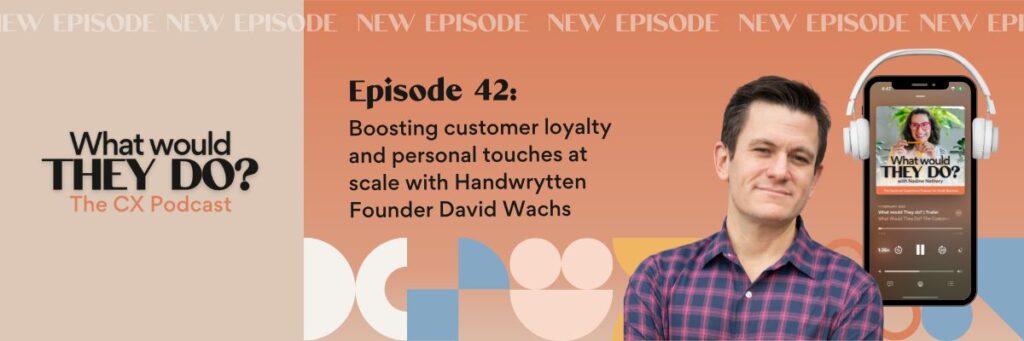
EPISODE 42 OF WHAT WOULD THEY DO? THE CUSTOMER EXPERIENCE PODCAST FOR SMALL BUSINESS OWNERS
NOTE: Some of the tools and resources mentioned in these shownotes could be affiliate links. That means when you click the link to create an account, start a free trial or make a purchase, it won’t cost you any more but I may receive a commission for introducing you. One thing I want to stress is that I would never recommend anything or anyone I haven’t successfully worked with myself or trust unconditionally.
In today’s episode, we’re diving into personal touches, handwritten moments, and how to make your customers feel truly seen, even if they’re scattered around the globe.
We’re answering this listener question:
“I would love to welcome all new members with a personal touch, but they’re scattered all over the world and it seems too complex and costly. What are my options?”
To help unpack this, I’m joined by David Wachs, founder of Handwrytten, a tech-enabled platform that makes sending physical handwritten cards as simple as sending an email. We explore the power of thoughtful gestures, why inbox fatigue is real (and growing), and how to scale meaningful experiences without burning yourself out.
Keen to try Handwrytten? Save 10% with signup code nadinenethery
Whether you’re a service provider, a membership founder, or a course creator, this episode will show you how to stand out in a sea of digital noise by doubling down on what makes you (and your customers) human.
My long-term 1:1 client and Retention Lab member Josh Goldsmith of techforword is our ‘guest expert’ inside the Lab in December to share exactly how he automates handwritten touchpoints in his business with Handwrytten. You’ll want a front-row seat for that!
What we cover:
Why retention and loyalty hinge on making people feel seen
What makes handwritten notes so emotionally powerful
Surprising findings from Handwrytten’s 2022 and 2025 consumer outreach surveys
Real examples of how brands increased revenue, loyalty, and LTV through handwritten outreach
How to balance automation and authenticity when scaling personal touches
Where AI belongs in the personalization journey, and where it doesn’t
Why intention is more important than handwriting, and how to keep it personal at scale
Soundbites:
David Wachs: “The problem is selling is so sexy, right? But the dashboard for client retention there’s not as much fireworks around it. It loses focus, even though it’s more important. One of the most expensive things is acquiring a customer. Why not just cultivate the relationships you have versus go out and get new ones?”
David Wachs: “We showed them a handwritten note, a printed letter, we said a phone call or a text message. And by and large, the number one way to make someone feel appreciated is through sending a handwritten note. So you can get all these great benefits of buying more often, referring more, rating and reviewing, and buying larger ticket items with something that is relatively inexpensive and kind of cuts through that dim.”
David Wachs: “I believe people buy based on emotion. They say they buy on with logic, but in truth, they’re buying with emotion. And a handwritten note is a great way to tap into that emotion in a way that emails and texts just simply don’t do.”
More about my guest, David Wachs:
A proven entrepreneur, David’s latest venture, Handwrytten, provides scalable, robotic solutions that write your notes in pen. Used by businesses in all industries and nonprofits, Handwrytten changes the way brands and people connect.
Prior to Handwrytten, David founded Cellit, a leading mobile marketing platform. With clients including Abercrombie and Fitch, Walmart and more, Cellit was sold in January of 2012.
Both Handwrytten and Cellit were on Inc. Magazine’s Inc 500 list of fastest growing companies.
David is a speaker on marketing technology, has been featured in the Washington Post and Wall Street Journal, and is a contributor to Inc. Magazine.
David’s Instragram: https://www.instagram.com/dbwachs
Handwrytten’s Instagram: https://www.instagram.com/handwrytten
😍 Love the show?
Submit your question so I can answer it in an upcoming episode (or invite the perfect guest expert!).
Post a screenshot with your key takeaway on your IG story and tag me @candocontent and #WWTDpod so I can repost your content.
Your next steps:
Find out how you can get my strategic customer experience brain on your brand here.
Grab the FREE State of the Customer online business industry report with first-hand findings, gaps & opportunities PLUS proven strategies to boost your customer experience. Download FREE here!
Join the Retention Lab, the membership for savvy online business owners determined to grow their revenue, referrals and repeat business without more marketing. Join here!
Check out my favourite CX tools and resources here.
Episode Transcript:
Nadine Nethery (00:00)
Hello, hello and welcome back to another episode. Today we’re exploring a question focused on personal touches and unexpected customer delight, my favourite topic. And here is today’s question. I would love to welcome all new members with a personal touch, but they’re scattered all over the world and it seems too complex and costly. What are my options? So to answer
this question, I welcome to the show the founder of Handwrytten David Wax. David and I, funnily enough, connected a little while ago around the same time that one of my Retention Lab members and long-term one-on-one clients, introduced me to Handwrytten. So the stars aligned, it was perfect timing. And, yeah, I was really hooked by the clever ways that Josh uses, Handwrytten in his membership business. So,
Welcome to the show, David.
David Wachs (00:53)
Thank you so much for having me, Nadine. And it really is quite the coincidence. So that’s amazing. And I’ll have to reach out to Josh after this and thank him for using it.
Nadine Nethery (00:59)
Perfect timing. You have to, yeah. So before we dive in, why don’t you introduce our listeners to the concept of Handwrytten also who you are obviously, and the bigger mission that you’re on.
David Wachs (01:13)
Sure, so yeah, I’ll start with me because it kind of ties in. So ⁓ I’ve been running Handwrytten for 11 years now, but prior to Handwrytten, I had a text messaging company. And we’d send all the way back to 2004, and we’d send a million texts a day for large brands in America, such as Abercrombie and Fitch, and Toys R Us, and Sam’s Club. And I exited that company, and what I realized was, what we were doing was great and it was working. mean, when we’d send out an offer for Tropical Smoothie Cafe, they’d have lines around the block. So it works. But at the same time, I kind of saw the writing on the wall because everybody’s receiving a million texts a day and a million emails, or technically they’re actually receiving 134 emails and spending 24 % of their time just managing their email inbox. Then you add Twitter.
Facebook messaging and now 11 years later Slack and Teams and all the rest. It’s really just overwhelming. On top of that, nowadays we’ve got all the AI generated stuff flooding our inboxes thanks to companies like Instantly and all that that are generating these cold emails by the millions.
Handwrytten was really created to kind of break through that din of electronic communication where everybody’s going into the electronic inbox. We wanted to tap the most unused inbox, which is the one at the end of your driveway. And really, A, get into that short stack of Handwrytten notes you get a month. You only get two or three a month in the United States versus being in the hundreds a day in the email.
A nice secondary effect is, know, people, it’s my belief and I’m sure you have a counter belief or, you know, an idea we can, we can kind of go back and forth on, but I believe people buy based on emotion. say they buy on with logic, but in truth, they’re buying with emotion. And a Handwrytten note is a great way to tap into that emotion in a way that emails and texts just simply don’t do. I’ve never seen anybody.
print out a text message and stick it to their bookshelf, but people take their Handwrytten notes, they put them on display. It’s crazy. So that’s really why we started Handwrytten was to kind of make sending authentic Handwrytten notes as easy or easier than sending an email.
Nadine Nethery (03:34)
Yeah. Hmm, such a clever concept and I can totally relate. I have conversations with my kids all the time. I have three ⁓ kids ranging from six to 14 and they always complain how I get all the mail, which obviously are all bills and invoices and things like that. But I do receive, thank you notes from businesses that I work with. So it is that element of surprise when there’s something in my PO box or in my letter box and it just… captures your attention, like you drop everything else and just take a moment to appreciate that personal touch.
David Wachs (04:14)
Yeah, it’s kind of like, you when I get them in my inbox, I will put them at the back of the stack because I’ll go through the bills and the junk mail first, and then I want to save the actual Handwrytten notes as kind of dessert. So, and I don’t think I’m unique there. think a lot of people do that. Save the good stuff for last.
Nadine Nethery (04:29)
Mm. No, I actually, I have my stash here next to my desk of, thank you notes when I was speaking at a summit or worked with someone, spoke a podcast. So I keep them. It’s funny. Definitely such a clever concept and yeah, inboxes are busy. People are just simply not paying attention to stuff that lands in inboxes the same way as they used to. So I’m
a huge data nerd and audience research nerd. So when I looked into Handwrytten and came across your customer or consumer outreach survey, I think you call it, ⁓ I was super intrigued. So I wonder whether you can share some of the firsthand findings with our listeners that stood out most to you when it comes to, how consumers engage with handwritten content.
David Wachs (05:03)
Yes. ⁓ Yeah, first of all, kudos to you for finding it. Very few people do, but it’s something we’re really proud of because we’re trying to be a thought leader in the consumer outreach space, not just Handwrytten notes, but try to think a little bit more broadly. So we’ve done this twice now. Once in 2022 and again in 2025, we did a survey of 2000 consumers blind. We didn’t know any of them. We just reached out through a survey company and we asked them pretty much the same set of questions during both time periods. And the number one was, you know, how do you reach, the first question was how do you reach out to people? And it’s no surprise that nobody’s sending handwritten notes anymore. They’re sending text messages. Text messages actually beat phone calls now, which is interesting. And then the, so that was,
Nadine Nethery (06:02)
I can relate, yeah.
David Wachs (06:06)
Not that surprising. I mean, obvious. But those that are sending Handwrytten notes tend to skew more affluent. ⁓ Now, none of this means they don’t like receiving handwritten notes. It’s just they don’t tend to do it, which I get. I mean, why would you drive an ox cart when we have automobiles? The next thing we asked is what’s the most personal form of communication? And we asked them, it emails, phone calls, text messages, junk mail, handwritten notes, or… I think that was it. And the answer actually was phone calls. But when we paired that with what’s the most annoying form of communication or what can be the most annoying, number, handwritten notes was the second most personal form of communication. We then asked them, okay, what’s the most annoying form of communication? And again, phone calls was number one and Handwrytten notes were the last. So,
Nadine Nethery (06:55)
Of course
David Wachs (06:59)
If you’re trying to walk that balance between highly personal and not annoying, Handwrytten notes are a great way to go. also probably to me the most interesting because we do have two time periods to compare against. We asked people if they felt appreciated by brands and only 12 % or you know, whatever that is one in eight consumers really feel appreciated by the brands they buy from. This is down from 18 % just three years ago. that’s like a, I know it’s percent to percent, but it’s about a 33 % drop in perceived brand loyalty, which is kind of frightening. So then we said, okay, well, you don’t feel appreciated by brands. What if you did feel appreciated by brands? What would you do? And it was all the good stuff. It was spend more per purchase, purchase more frequently, rate and review more often, and refer more to friends and family. They would do all of those things if they felt appreciated. In 2025, they tend to skew more towards ratings and reviews and referring more to friends and family versus 2022, they buy more and buy more frequently. I think that’s kind of a sign of the times in the States. People don’t have as much money, but they’re willing to serve as a influencer or advocate, you know, and refer you around. So then we said, okay, well, what would make you feel appreciated by these brands? And again, we showed them a handwritten note, a printed letter, we set a phone call or a text message. And by and large, the number one way to make someone feel appreciated is through sending a handwritten note.
So you can get all these great benefits of buying more often, referring more, rating and reviewing, and buying larger ticket items with something that is relatively inexpensive and kind of cuts through that dim.
Nadine Nethery (08:45)
Hmm. Yeah, it’s such interesting findings and so in line with, as you said, budgets shifting. Australia is the same. Everyone’s tight Costs are going up, so I can relate to people not spending more, but then advocating in return for your brand. So I have to say I did try Handwrytten after booking you for the show, you know, sending a card. So I sent a card to a long-term member in the US who hit a milestone and it was just so easy.
Like I loved how easy it was. She loved receiving it. It was super easy to, you know, upload my branding. It arrived quickly. it sounds like an ad. It’s not. I just wanted to share that it’s such a low lift way to infuse those personal touches without physically having to go to the post office, you know, like it costs a little bit from Australia to the U S and there is that barrier to actually, yeah, fitting it into your day. Right. So Until
then, just as a little bit background, so long-term listeners would know my 14 year old daughter, she’s officially my gifting manager for one on one clients. Yeah, yeah, she loves it. She’s quite creative. And so her job is to package, my official welcome gift, nothing expensive, but again, personal handwritten cards, a little bit of something that matches my client’s personality. And she’s just, you know, all across it and it definitely works a trade. So I totally agree that it’s not the monetary value. It doesn’t have to be anything expensive. It’s just the gesture of reaching out, spending that time, thinking of them, going out of your way. one quest, yeah, it’s just showing that you care. I feel, know, they’re not just a number. It’s not just a transaction. One thing I’m wondering though, how…
David Wachs (10:26)
Yeah.
Yeah, it’s that investment in time is what I always say.
Yeah.
Nadine Nethery (10:40)
Do people respond to you when you present Handwrytten and the automated approach to the handwritten card? The magic of handwritten cards is that it’s personally handwritten. How do you deal with that?
David Wachs (10:46)
Yeah. Right. Well, there’s a couple ways. I’ll give you the most common way I think about it and then some additional ways because I do give this a lot of thought. The most common way I say it is it’s often not a question of Handwrytten with a Y my company or handwritten with an I the person doing it, right? It’s often the choice of Handwrytten with a Y my company or nothing because you’ll sit down as I did before having Handwrytten and you’ll want to write a bunch of notes and you’ll get through a small stack of them and you’ll say, to hell with it, I don’t have the time to do this. So it’s really not the choice between doing it the quote unquote right way, which would be the best way to do it. But if you’re growing a brand, you just simply can’t do it. So then the other choice you could do is you could hire a bunch of interns to do it or your 14 year old daughter to do it, which is great, but it’s also not you. And then you’re just running the risk of not with the case of family, but you’re running the risk of spelling errors or poor handwriting after the fifth note or an employee going rogue and writing the wrong thing. know, a lot of nonprofits use like volunteers and they give them a lot of pizza to do it, so then you get pizza grease on the notes, know, whatever. whether it’s a robot that’s consistent in style and approach versus a person, neither way it’s you. So, you know, what I say, I’m kind of getting into my second level thinking here. You want to use AI for the mechanics, for the logistics to get the note out. You don’t want to use AI for the intention. So we have, we do, because we wanted to be first to market, you can go on Handwrytten.com and use the little AI assistant and it will write the note for you. But I often, I rarely use that. I always just write the note myself. mean, you need to put your intention into it. And I think that’s the important part. And a lot of people will want to say, well, can I just connect Zapier to ChatGPT or can we go straight Zapier to…
your AI assistant and then out the door and I say, don’t really do that. We don’t want to run the risk of it sending a bad note, but I suppose you could through chat GPT or whatever else and then connect it to us if you’re really that dead set on it. But I think that kind of misses the point. You still want it to be your voice and your intention. We just use the robots to do it so that you can scale your outreach and your gratitude because It’s great to thank five people, but isn’t it better to thank 500? Or even during the holidays, you know, you have a Christmas list and usually you’d only have time to get out 100 Christmas cards. But now you can get out a thousand Christmas cards in less time and probably cheaper than getting out the hundred. So it’s just, you know, how can we leverage you to be as, as, as gracious as possible with your, with your sphere.
Nadine Nethery (13:54)
Mm. Yeah, such an interesting perspective because it’s so true. You know, you get to card number five and it’s just not happening. So while I’ll keep sending out my welcome gifts to one-on-one clients, I definitely can see a space for Handwrytten, particularly in my membership processes. So that’s something I’m currently looking into. ⁓ Yes, I know, right?
David Wachs (14:07)
Well, let’s talk after the show then.
Nadine Nethery (14:28)
I know you’ve worked with a whole bunch of businesses across industries, niches. So is there anything that stands out to you where someone has used Handwrytten and it’s directly impacted their bottom line, their referrals. I’m sure businesses are sharing success stories with you all the time.
David Wachs (14:46)
You’d think that, but they don’t. Unlike an electronic tool where we’re kind of in the loop, we’re really out of the loop. We send the mail and we hope for the best and we often don’t hear. A few clients have told us what’s going on, but we know it’s working because they stick around, the clients. But what I can tell you, I do have a couple examples for you. one is a snack box subscriptions. So they send, you know, you can sign up as an office and they’ll send your office snacks every two weeks or every month. And occasionally they’d screw up. Either they’d forget to send you the box or they’d send you the wrong box or it would arrive damaged. So what they started doing was sending a follow-up box with a Handwrytten note apologizing for their mistake. And of course the extra follow-up box helped, but so did the Handwrytten note because what happened was those customers ended up with a higher lifetime value than customers that were never screwed up with in the first place. So their solution, when they saw this, they had an aha moment and they realized, well, why don’t we just screw up with everybody and then raise all LTVs? And that’s exactly what they did. Now I’m not saying that’s for everybody, but that’s what they did. ⁓
Nadine Nethery (15:43)
Mmm.
Yep. It’s so true though, isn’t it? Like if you stuff up, it’s how you deal with that mistake. You know, like people don’t get upset about the mistake. It’s about how you address the after.
David Wachs (16:05)
⁓ yeah, I’ve got a whole framework. Yeah. And I don’t know how it is in Australia, but in the States, nobody takes any responsibility anymore. There’s something that happened about 10 years ago and ever since then, nobody, nobody takes any responsibility. I’ve, yeah. but so that’s one. Another one is, a, a car dealership that we work with here, actually in Arizona. And they, and other side point of Handwrytten is we never mentioned client names.
Nadine Nethery (16:17)
Yeah, nobody’s fault. Yeah.
David Wachs (16:37)
We just know, you know, so nobody wants to be known as sending anything other than genuine. we, we let, we, we, are their little secret. ⁓ So a car dealership was using printed notes or printed letters and they switched to us and they were sending out invitations that basically asked people to bring in their car to trade in or trade up to a new car. When they switched to Handwrytten notes, they signed 18 times not 18%, but 1,800 % increase in dealership visits from the cards versus the letters. And yes, the cards were substantially more than a letter. There’s a lot more that goes into it. But even accounting for that, it was about a seven times greater ROI than the printed letters are, and highly successful. We have nonprofits that’s that do donor outreach once a quarter and they see about a 30 % ROI on that. We have a chain of eyeglass stores that what they do is every time they open up an eyeglass store in a location, they look at who’s bought eyeglasses from them in the past and they send Handwrytten notes to everybody in the neighborhood inviting them in to the new store and that consistently drives a lot of traffic too. But our number one use case is just sending thank you notes, holiday and birthday cards. Those are kind of, yeah.
Nadine Nethery (18:02)
Yeah. Yeah. I love the pattern interrupt. We all receive the advertisement from the local plumber in the letterbox, all printed, all terrible, it goes straight to the bin, right? Handwritten, It just interrupts the thought processes and goes straight to the top of the queue. So good. Yeah.
David Wachs (18:11)
Yeah. Absolutely. We have another company that does bespoke. Like you send in your measurements and they make bespoke suits and they send a Handwrytten card every Christmas to their top clients and they do include a coupon code, which I wouldn’t do. I think it would kind of ruin the impact of it. But they do and they see a redemption rate that’s about five times greater than their other coupons And then we have a clothing brand, and this one doesn’t really have a story attached to it, or a fact attached to it, but we have a very popular clothing brand out of California using us, and all the notes are signed by the CEO, and he goes off to parties, and people come up to him at the party saying, hey, I got that note you sent me. And he has no idea what they’re talking about, but it’s pretty fun.
Nadine Nethery (18:59)
You Just run with it. Just go cool. Yeah. Awesome. Love it. my God. I would love to, I know it’s probably too complex to cover in the podcast and in its entirety, but just talk me through the process that it takes to scale sending Handwrytten cards, like my client who’s doing it all automated without lifting a finger. Is it complex to pull off or how does it work?
David Wachs (19:11)
Yeah, great. Yeah, no, it’s pretty easy. Well, you went through yourself, so you saw you can create your own card. The card customizer is a bit basic, but it’s usable. I can go and whip a card together in two minutes. If you really have problems, you can go to Canva, create an image, and then import that. Yeah. So you create your card, and once you create that card, then it’s usable in any automation. But directly
within Handwrytten, and I don’t know if you saw this Nadine, you can, and I don’t want to sound like a sales pitch here either, but you can go into Handwrytten and click your name in the upper right and choose campaigns. And there’s a prospecting feature where you can kind of circle an area on a map. I don’t think that would be of use to you, but there’s also a birthday anniversary feature, which you can use for client anniversaries as well. So what I would do to make an Automation without having to use Zapier or make or an 8n or anything. Just go in there put in all your your clients when they joined your service and then Every year we’ll just send them another Thank you note and you know in the states we can include gift cards to Starbucks or whatever But you know, it’s a very simple way to do it if you’re looking to do anything more complicated than that from an automation It’s really easy to use Zapier well, it used to be really easy to use that beer. Zapier has gotten a little bit more annoying now that they’ve grown. So I recommend make, which is a really good, if you’ve used that it’s. It’s Zapier has kind of, I think, kind of lost their way, but anyway, neither here nor there, with any of those tools, whether it’s Zapier make N eight N Pavley connect, any of them, you can just use the Handwrytten module that’s built in. And it’s very, very simple to connect to whatever platform. So for instance, if you’re in pipe drive and you move the prospect to the next stage, you could send that. I don’t know what platform you use for your business.
Nadine Nethery (21:33)
Yeah, I’m just even thinking for my membership, for example, does it connect with email platforms? So if someone is tagged a certain way, could that trigger? Yeah, because like my top tier in my membership, I definitely have the address in my email platform. So that could be something. My brain is spinning.
David Wachs (21:41)
Yeah, if there are dress if there are dresses in there, you could do it for sure.The other thing you could do, and I don’t know if people want to do it, but within Handwrytten you can. And again, I don’t know, it gives away the secret a bit, but you can send them, when you go into add an address to the address book, you could just add their email address and hit send, and then Handwrytten will actually send them little email saying fill in your address, and then you get free credit. They get free credit for doing that. But it gives away your secret.
Nadine Nethery (22:16)
It’s the unexpected that has the highest impact I reckon so but yeah it’s so cool. So I wonder what is your favorite note that you have ever sent or ever received? If you had to pick one what would that be?
David Wachs (22:22)
Yeah. Right. I have a letter that a woman, a client from IKEA, at my last company, she wrote me a whole glowing letter saying how great we were and I’ve got that letter framed behind me. It’s just, it was so amazing to see somebody to take the time to spread that type of gratitude. So that I would say that, but other notes I’ve received. what I would say is one of our clients during COVID was sending out notes to people that called into their customer service and somebody called them back crying because they felt seen and during COVID they were all isolated. It kind of broke my heart, but I think it’s just a sign of the times with COVID and everything. As far as me, I mean quite frankly, I found an old love letter from when I was like 13 that has lipstick marks on it. So I keep that one as a nice little keepsake. But no, mean, you know, that type of thing. Nothing too serious. Yeah.
Nadine Nethery (23:30)
⁓ I love it. ⁓ There’s probably a few. Yeah. But it’s funny how, how a certain type of note they stand out and they leave a mark. Yeah. Awesome. So you might not have listened to the show, David, which is totally fine, but I ask all my guests one question. So if we flip the coin and, have a look at you personally.
David Wachs (23:43)
Yeah, yeah.
Nadine Nethery (23:58)
What is the top customer experience obstacle question headache you have and would love either me or a guest expert I invite onto the show to answer for you.
David Wachs (24:10)
You know, for us, it’s really as our clients grow, how do you continue to stand? mean, and I don’t know how, you know, scales of business are all different, but we’ve got, you know, tens of thousands of active clients. How do we stay in touch with them and reach out to them in a, in a reason? mean, obviously we can send them Handwrytten notes, but how do we stay in touch with them in a frequent basis where they know they’re being looked after and cared for versus just spanning them with emails. ⁓ That’s what we’re talking about here internally is we really want to grow. It’s not like we have a retention problem. We just want to cultivate the clients we have, obviously upsell them, but also just provide better service.
Nadine Nethery (24:38)
Staying front of mind is so hard, right? Because once they’ve been there, it becomes business as usual. love the question. Let me see who I can invite to look at scaling while still having impact. ⁓
David Wachs (25:12)
Yeah, know, the problem is everybody, know, selling is so sexy, right? Like, the return on ad spend, the, you know, the new client, you all these dashboards you build in HubSpot or whatever, that’s all sexy. But the dashboard for client retention is not as, there’s not as much fireworks around it. And because it loses focus, even though it’s more important. You know, one of the most expensive things is acquiring a customer. Why not just cultivate the relationships you have versus go out and get new ones?
Nadine Nethery (25:39)
Hmm. I 100 % agree, which is why my membership is called Retention Lab. I’m on the mission to get people in. So you’re on the same wavelength here. Thank you so much for coming on the show, David. This was such a good chat. I’m sure listeners have tons of ideas. And if you want to check out Handwrytten, please do so. I’ve added a link to the show notes here to make it super easy for you.
David Wachs (25:48)
Yeah. I’m in.
Nadine Nethery (26:06)
And as it happens, my one-on-one clients and retention lab member, Josh, is actually coming into the membership in December to share the automations that he uses to look after his members in his membership business without lifting a finger. So if you’re curious to look behind the scenes, make sure you join us in the lab. And if you enjoyed this episode, make sure you leave a review, hit subscribe, follow in all the places. Thanks so much for tuning in and I will see you next week.