











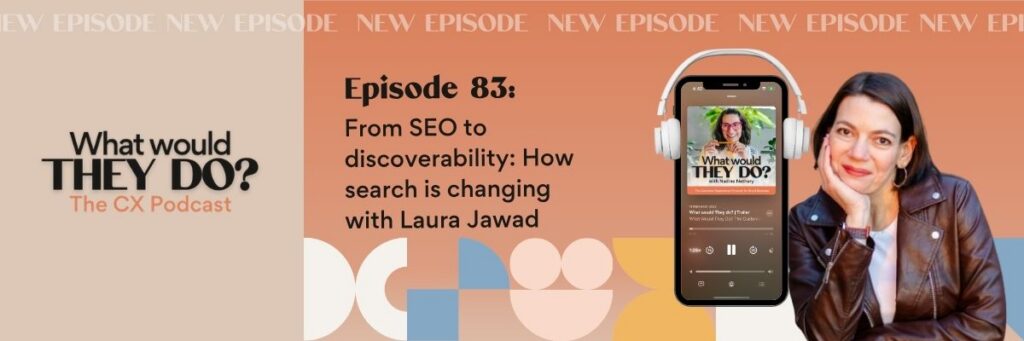
EPISODE 83 OF WHAT WOULD THEY DO? THE CUSTOMER EXPERIENCE PODCAST FOR SMALL BUSINESS OWNERS
NOTE: Some of the tools and resources mentioned in these shownotes could be affiliate links. That means when you click the link to create an account, start a free trial or make a purchase, it won’t cost you any more but I may receive a commission for introducing you. One thing I want to stress is that I would never recommend anything or anyone I haven’t successfully worked with myself or trust unconditionally.
SEO isn’t just about keywords and Google rankings anymore.
Your potential customers are searching everywhere, from Google and YouTube to ChatGPT and other AI tools. And increasingly, those platforms are trying to understand who you are, what you’re known for and whether you’re a credible source worth recommending.
So what does that mean for the way you approach SEO in 2026?
In this episode, I’m joined by SEO strategist Laura Jawad to explore why it’s time to think beyond rankings and start looking at your entire online footprint.
We’re talking about the connection between SEO, discoverability, reputation and customer experience, plus what actually helps Google and AI search tools understand what you should be known for.
If you’ve ever worried that AI search means everything you’ve learned about SEO is suddenly obsolete, this conversation will put you at ease.
What we cover:
Why SEO is no longer just about keywords and rankings
The difference between rankings and true discoverability
How AI is changing the way potential customers search for businesses
The importance of consistently talking about what you want to be known for
What Google and AI look for when deciding whether you’re a credible expert
Where SEO fits into the customer experience and customer journey
The 3 things Laura would prioritise to become more discoverable over the next year
Soundbites:
Laura: “Whether we’re talking about Google or AI search systems, they’re really trying to answer a bigger question: Is this a good result for this searcher? We’re now evaluating the source behind the content. And so SEO is the whole online reputation, the whole online footprint, which quite honestly, I think makes it so much more interesting.”
Laura: “Google still serves the lion’s share of searches. Absolutely, people are increasingly using ChatGPT, Perplexity, Claude for search. There’s different things that I use them for, but in a lot of cases, I want to be the one choosing what websites my information is coming from, especially if I’m interested in hiring someone.”
Laura: “The foundations of discoverability, whether we’re talking about Google, whether we’re talking about AI, they are the same. And quite honestly, if you’re not showing up in Google, you’re probably not going to show up in an AI because you’re not doing the right things to get found in the first place.”
More about my guest, Laura Jawad:
Laura Jawad is an SEO strategist who helps service providers become more discoverable in the places their customers are searching for their expert of choice. Instead of telling you to game algorithms or chase rankings, she’s relying on building authority, reputation and trust so that when someone goes looking for answers, your business becomes the obvious choice.
Website: https://www.laurajawadmarketing.com/
Instagram: https://www.instagram.com/heylaurajawad/
FREE SEO Scorecard: www.laurajawadmarketing.com/what-would-they-do/
😍 Love the show?
Submit your question so I can answer it in an upcoming episode (or invite the perfect guest expert!).
Post a screenshot with your key takeaway on your IG story and tag me @candocontent and #WWTDpod so I can repost your content.
Your next steps:
Find out how you can get my strategic customer experience brain on your brand here.
Grab the FREE State of the Customer online business industry report with first-hand findings, gaps & opportunities PLUS proven strategies to boost your customer experience. Download FREE here!
Join the Retention Lab, the membership for savvy online business owners determined to grow their revenue, referrals and repeat business without more marketing. Join here!
Check out my favourite CX tools and resources here.
Episode Transcript:
Nadine (00:00)
So what if the customer experience begins the moment someone realizes they have a problem and start looking for someone they can trust? In today’s episode, we’re looking at a question that is front of mind for many business owners right now. What would you do to no longer be the best kept secret in your industry?
And joining me today to reflect on this question is Laura Jawad an SEO strategist who helps service providers become more discoverable in the places their customers are searching for their expert of choice. What I love about Laura’s approach is that instead of telling you to game algorithms or chase rankings, she’s relying on building authority, reputation, and trust so that when someone goes looking for their answer, your business becomes the obvious choice.
Laura, welcome to the show.
Laura (00:49)
Thank you so much, Nadine. I’m really excited to talk with you.
Nadine (00:52)
So good to have you. We were just chatting before this recording. We’ve been in each other’s worlds for quite some time, but for whatever reason, have never managed to chat one-on-one. So this is a great opportunity to pick your brain. I love your approach to SEO and the more holistic look at showing up in all the right places. So I can’t wait to dive into things. But before we get started, do you want to give people a little bit of an overview, what you do?
and how you got to where you are today. I always find that super interesting as well. and then we get stuck in.
Laura (01:23)
Yeah, absolutely. So you’ve already told them that I’m the girl you call when you want to get found on Google or get cited by AI search tools. but my background is actually in science. So I’m a PhD trained oceanographer and
the trajectory from there to here, as you might imagine, wasn’t linear. essentially
I left my academic position in 2018 to start a pregnancy and postpartum personal training business to kind of satisfy some services that I needed that weren’t available. I grew that business with SEO and then started helping
other people with their SEO and ultimately decided to productize that. and that brings me to where I where I am now. And I do this full time. So
Nadine (02:11)
How cool.
I just love how so many, particularly female founders, I feel they just come into their business from the side, completely somewhat unrelated
Laura (02:19)
I love it.
Nadine (02:21)
to studies or like I know a whole bunch of lawyers who never went into law but now do marketing. I’m just so intrigued with the, creativity, and the
entrepreneurial
Laura (02:31)
Yeah.
Nadine (02:32)
spirit that us women have, particularly around having kids, I feel like that’s often the pivotal moment where either something happens to you where you get made redundant and have to look for something else, or like in your case where you have a need for something, there’s a real gap and then you fall into it that way.
Laura (02:48)
Yeah. Yes. Parenthood is definitely a forcing function for a lot of people. Mm-hmm.
Nadine (02:51)
It is, isn’t it? Yeah.
Yeah. I I was made redundant on mat Leave, which was the catalyst for my business journey. And I feel like so many women I talk to go through the same. But that’s something for another. For another time, right? We could talk for hours.
Laura (03:04)
Yes. That is another conversation.
Nadine (03:07)
I know. so let’s get stuck into all things SEO. So as someone who’s worked in, copywriting for quite some time, I
Do know SEO and appreciate it and, keep reminding clients about the importance as well. But I’d love to hear your take on things. When people hear the term SEO, what’s often the biggest misconception that they have at the time?
Laura (03:28)
I think that the the biggest misconception about SEO is that it is all about keywords and rankings. And I think that,
you know, once upon a time, that was true, but search has changed so much. And so now, whether we’re talking about Google or we’re talking we’re talking about AI search systems, you know, they’re really trying to answer a bigger question of, you know.
Is this a good result for this searcher? Right. And they’re evaluating results on so much more than just keywords and rankings, right? We’re now evaluating the the source behind the content. And so SEO is bigger than the website. It’s about like the whole online reputation, the whole online footprint, which quite honestly, I think makes it so much more interesting.
Nadine (04:19)
Hmm, absolutely. again, like a lot of my clients, when they come to me are all about, I need my blog to rank on page one. but it’s more about discoverability and that bigger footprint, as you said, than ranking with one blog post. Of course that helps. But
how would you describe the distinction between discoverability and your online footprint, as you said, compared to rankings?
Laura (04:40)
Discoverability is an outcome and rankings are kind of one expression of that. You know, people are going to discover you in many places. It could be
traditional Google search, it could be the map pack or local search. It could be on YouTube. It could be ChatGPT. It could be all kinds of places. Rankings are
one way that we can measure discoverability, but they aren’t the ability to get found. Right.
Discoverability is how easy is it for people to find you wherever they’re searching.
Nadine (05:11)
Yeah. And as you said, nowadays people search in so many different places. I
Laura (05:15)
Yeah.
Nadine (05:16)
feel a few years ago, if you ranked on Google, you did pretty well. You knew people would eventually find you if you set up your website correctly, if you had a few blog posts out there, they were set up strategically. How do you think AI and AI search particularly is changing the way that businesses need to think about visibility?
Laura (05:34)
we’ve got to start thinking beyond just optimizing individual pages. you know, we we talked about this a moment ago in that search systems, whether we’re talking about Google, whether we’re talking about AI, they’re not just evaluating a page anymore. They’re forming an opinion about the source behind the page. So when you’re thinking about visibility, you really have to think about your whole reputation online, your
whole
Online footprint. And so, you know, is your expertise clear across the web? Is it reinforced consistently? Are other people talking about you? Are they mentioning you? Are they inviting you onto their platforms? is there enough evidence available out there for these systems to connect your name or business with that topic that you want to be known for
and surfaced for?
Nadine (06:25)
Yeah. So is consistency really important then?
if you’re talking about sort of keywords being less important, it sounds almost like you need to repeat yourself,
talking about topics consistently, so then the AI
tools and Google link you to a certain topic. Is that how how you look at it?
Laura (06:45)
with respect to consistency, like LLMs, the large language models that drive these
AI search tools, they are trained on repetition.
so you have to show up with consistent, not just messaging, but even just the way that you refer to yourself and your
your job and the people that you serve, you have to talk
about this stuff the same way over and over and over so that these models start to link your name with these kind of entities, right?
Nadine (07:18)
Yeah.
Laura (07:19)
So, you know, when I talk about myself, I talk about myself as an SEO strategist all the time. Right.
I can’t call myself an SEO consultant sometimes or an SEO magician other times or like whatever I might want to, right? I call myself the same thing every
Nadine (07:32)
Yeah.
Laura (07:33)
time and I s and I
try to talk about not exactly the same thing over and over and over because that’s boring. But
you know, I do try and stay focused around the same kind of topic pillars to establish
It’s not exactly repetition, but it’s consistency, right? So I’m I’m
Nadine (07:50)
Consistency, yeah.
Laura (07:51)
associated with consistent topics.
Nadine (07:56)
So it’s even more important nowadays to sound like a broken record. Here’s your permission. Sound like a broken record. Literally bang
Laura (07:59)
Yes. Yeah, it is. Yeah.
Nadine (08:04)
on about what you do, In very consistent terminology. Yeah.
Laura (08:06)
Yeah, but I I mean you can address things you can address things from different angles. You know, like I think that’s okay, but you wanna
you wanna keep circling the same
Nadine (08:15)
Yeah.
Laura (08:15)
topics that you wanna be known for.
Nadine (08:17)
Yeah. So it’s you know, normalizing that consistency, shifting mindsets from one off.
Laura (08:22)
Yeah.
Nadine (08:24)
SEO always felt like a one-off thing, like we need to create a one-off blog post for this keyword. So I love how you are talking about that consistency and the bigger picture and having the pillars that all link back to.
that unique identifiable way AI or Google thinks about
Laura (08:38)
Yeah. And for example,
Nadine (08:40)
you.
Laura (08:41)
yeah. And for example, you know, thinking about the blog post, right? Like what
are the content pillars that you’re creating content for on your website? Those should be the same content pillars that you are exploring when you’re pitching podcasts or when you’re giving talks in a summit or, you know, when you’re showing up in other places, you know, the stuff you’re doing off your website
Nadine (09:02)
Yeah.
Laura (09:02)
and on your website should reinforce each other.
Nadine (09:06)
Mm. So it’s even more important to say yes to the right opportunities and have that, sense check when you get approached for random summits that don’t align with what you do.
Laura (09:17)
It makes it a lot easier for me to say no to things.
Nadine (09:22)
Yeah, it’s just another lens, right? Like, does it fit into
Laura (09:24)
Yeah.
Nadine (09:24)
the bigger picture? Is this going to be valuable? is it going to send the right people into my world? But also, does this link in any shape or form to what I want to be known for? so in twenty twenty-six, with AI everywhere,
I feel a lot of people are shifting their search behavior. have you noticed a shift that we need to keep in mind? again, when it comes to
how we serve people, how our content also served in different platforms.
Laura (09:51)
So Google still serves the lion’s share of searches. I
think the number is 14 billion searches per day.
Nadine (09:58)
Wow.
Laura (10:00)
I think that’s the number. I’m not always good at remembering numbers, but ChatGPT serves about 10% as much.
And that is all queries, right? It’s not that’s not even just, you know, people use ChatGPT for all kinds of things.
Nadine (10:16)
Yeah.
Laura (10:16)
So absolutely, people are increasingly using ChatGPT perplexity claude for search, but a lot of people are still.
using Google. I still use Google.
There’s there’s different things that I use them for.
but in a lot of cases, like I want to be the one
choosing
what websites my information is coming from, especially if I’m if I’m interested in hiring someone or looking for a provider,
Nadine (10:45)
Yeah.
Laura (10:46)
I go to the search results. So I think I think there’s definitely a shift, but I think it would be
ill advised to assume that everyone has gone to
those tools. There’s still a lot of search happening in Google as well.
Nadine (11:00)
Yeah.
And then, the same principles apply anyway to to AI search and Google searches, right? So, you
Laura (11:06)
yes. Yes, absolutely.
Nadine (11:08)
know, if you tick all the right boxes, you have that consistency, your online footprint, I think you’re gonna be fine.
Laura (11:14)
the
foundations, like I like to talk about foundations of discoverability, whether we’re talking about Google, whether we’re talking about AI, they are the same. You know, when we talk about optimizing for Google versus Chat GPT, we’re we’re operating at the pointy end of the stick. But the the foundational things are all the same. And quite honestly, if you’re not showing up in Google, you’re probably not going to show up in an AI because you’re not doing the right things to just
get found in the first place.
Nadine (11:43)
Yeah.
Yeah, so true. So true. if Google or ChatGPT or Claude, you know, wherever people are searching, had to form an opinion about my business today, what evidence would each platform or in general these platforms be looking for? I know we talked about, consistency, your footprint, the sources. is there anything else that plays into that?
Laura (12:07)
Well it’s kind of a trifecta, right? So first they’re gonna look at what you’re saying about yourself, and so they’re gonna read your
pages. And this is where like your about pages really important your about page is very important in terms of where these tools go to learn about
you. and that might might be a place where there’s a little difference between how those tools operate and how Google operates, but
Nadine (12:29)
yeah.
Laura (12:30)
your website.
And particularly your about page are a very important source of information about you. So that’s what you say about yourself, but then they’re also looking to see what other people say about
you. And that’s where this online reputation piece comes in. So they’re looking at, you know, where else you’re showing up, or
you know, like like this. I’m showing up on your platform, which implies that you trust me. There are reviews out there on the internet that these systems can read, they can learn about.
other
people’s opinions of you. So they’re not just taking your word that you are the number one expert in whatever. Like
Nadine (13:10)
Yeah.
Laura (13:11)
they’re looking to see what other people are saying and who else trusts you. And then there’s the consistency piece, right? They’re looking to see like how frequently and with what volume you kind of show up in these topical areas. Because are you actually an expert? Experts
create evidence, right? They’re
not just saying they’re an expert, they’re producing something. They’re producing content. And so are you showing up, producing content about the same topics consistently?
Nadine (13:41)
Hmm. How do you check your online footprint? I’m intrigued. do you just Google yourself and have a look?
Laura (13:48)
that’s a complicated question.
there’s a lot of different ways to think about it. So I like thinking about page one presence. So that is that’s when you Google yourself, right?
Nadine (13:57)
Yeah.
Laura (13:57)
In an incognito window. But search results are always personalized, even if you’re in an incognito window. It’s hard to 100%. Everybody’s
search experience is different.
But it is one way that you can start to look at what shows up when someone searches for you because, and it’s worth doing because even if your website is the number one result for your name, and I hope it is, people still see all the other stuff on page one. So you want to
Nadine (14:23)
Yeah.
Laura (14:24)
cultivate that page one presence, right? But okay, that’s a different conversation too. So Googling
Nadine (14:27)
Yeah.
Laura (14:28)
yourself is one way. there are all kinds of tools that sort of purport to
evaluate your AI visibility. And
those are also a little bit questionable because the way the way they do that essentially is choosing like a set of 10 prompts that you would ideally be cited
in an answer for. And
running those prompts and looking at how frequently you show up and like where in the list and what the sentiment is around your citation.
But that’s also subjective. Everybody’s AI is personalized for
Nadine (15:00)
Hmm. Yeah, yeah.
Laura (15:02)
them. So that is also very subjective. I like also looking at like your Google Search Console and just looking at the types of queries that you’re being found for. I think this is actually
a really great way to kind of evaluate how you’re understood online. So if you go to your website and
the top search queries on your website have nothing to do with what you do.
you can deduce from that that Google doesn’t really understand you.
Right. If they’re sending if they’re sending people to your website for the wrong traffic. if however you go and you look and it’s like, you know, people are finding you from your business name, from kind of top of funnel pain point searches, your branded solutions, then you know that the systems have a good understanding of who you are.
Nadine (15:48)
SEO, I feel often is put into the visibility bucket, right? It’s all about just showing up. But coming at it from a customer experience perspective, I feel you know how you show up in search and the SEO experience in itself is such a big component. Where do you think
search and SEO fits into the customer journey.
Laura (16:09)
I think there are so many ways to answer this question.
I think one way that you could answer this question is to consider that showing up for someone in search is part of the experience. Right. Like when someone has a problem and they’re looking for a solution, when you’re the one who shows up with a solution in hand,
you’re kicking off a great experience. Right.
Nadine (16:33)
Yep. Absolutely.
Laura (16:35)
I think you can
also consider it from the perspective of the goal of SEO isn’t just traffic, it’s getting clients or getting sales.
And so what happens on the website when someone lands there, in my mind, is also part of SEO.
Nadine (16:51)
It’s like that connecting piece, isn’t it? Like being
Laura (16:53)
Yeah, it’s
Nadine (16:54)
the logical choice and showing up, hopefully
Laura (16:55)
Yeah.
Nadine (16:56)
in a way that answers, that pain point and then connecting it into hopefully the user experience on the website and people find the message that they were looking for
But yeah, SEO is so
underrated and undervalued in that initial starting point of the customer journey.
Laura (17:13)
Yeah, I mean,
if someone is searching for a solution and they’re finding everyone but you, you’re not serving them.
Nadine (17:20)
Yeah.
Laura (17:21)
You’re not providing value to them. You’re not even part
Nadine (17:24)
Exactly.
Laura (17:24)
of the customer ex your experience, right? The
Nadine (17:26)
Yeah.
Laura (17:27)
way that you present yourself in search matters from that perspective.
Nadine (17:32)
Mm. From a different perspective, obviously, ideally, that dream customer journey kicks off with a referral
But if someone finds you through search, do you feel there’s a different mindset that people come into your world through? how does that differ
Laura (17:46)
Yeah. a referral shows up with borrowed trust.
In that case, I think your website doesn’t have to work as hard.
Nadine (17:55)
Yeah.
Laura (17:55)
But when someone finds you from search and they don’t already know you, and they’re a cold lead. And so you have to do all the work of building that know like and trust from scratch. And
so your website has to work a little harder. You have less wiggle room there.
when I think about you know, blog posts, for example, where a lot of cold leads will come in from, you know, people doing top of funnel searches are inherently
Nadine (18:19)
Mm. Yeah.
Laura (18:22)
cold traffic. There’s a lot of different ways to write a blog post. And even if we’re just talking about an informational blog post, not even a case study.
using story, using empathy, using voice of customer.
In the introduction
goes such a long way towards seeding that no like and trust, nurturing that no like and trust. Case studies are obviously wonderful. Not everyone
Nadine (18:45)
Yeah.
Laura (18:46)
will land on those, but I think regardless of what type of content it is, most people can do a better job with their introductions
whether that’s like a story, an anecdote, empathy, like providing their uncopyable perspective so they get to know you and understanding why you’re the person who should be
answering this question for them. And
Nadine (19:05)
Yeah.
Laura (19:06)
from the perspective of SEO and search and AI search right now,
Our content has to demonstrate information gain. And what that means is it has to contribute something new to the internet.
Okay. Because these search systems, like if it can be answered in an AI overview, if it can be answered from training data, it will be. So you have to offer
Nadine (19:28)
Yeah.
Laura (19:28)
something new in your content. So when you do these things, it not only stokes that no like and trust, like it helps warm up that cold relationship, but it also makes your content
More findable.
Nadine (19:43)
It’s so easy to fall into that trap, right? ten steps to something or how to
Laura (19:48)
my God. I love
writing a like an encyclopedic blog post.
Nadine (19:52)
Yeah.
Laura (19:52)
Like it feels so good. I have an academic background, but it’s something I’m having to really train myself out
of. And the result is always better.
Nadine (20:01)
So if you as the SEO expert could only focus on three things to become more discoverable, over the next year, what would that be?
Laura (20:10)
The first one would be really honing in the way I refer to myself and my services. So just getting really clear on this is who I am, what I do, who I serve, and then using like sticking with that language, using it everywhere. the next thing would be to create more content, right? Because if you want to get found,
you have to create stuff to get found. So creating long-form content for my website. and then
The last one would be showing up on other people’s platforms.
Nadine (20:38)
Yeah.
Laura (20:39)
So building that reputation, you know, we used to think of it as backlinks, but I think backlinks
Nadine (20:45)
Yeah.
Laura (20:46)
doesn’t tell the whole story anymore. But thinking about, you know, how can I show up on more podcasts in in more places where I’ll get seen outside of my own website.
Nadine (20:58)
Yeah, that’s my big focus as well because as you said, borrowed trust. People who hear you on their
Laura (21:02)
Yeah. There’s so many advantages.
Nadine (21:04)
favorite podcast, you’ve got an easy way in. and that baseline of trust that’s already established. but yeah, very interesting. I I’m sure you’ve heard so as we’re recording this today, it’s just been announced that Claude is adding
this what do they call it like a signature, hidden signature, watermark, that’s right, to
Laura (21:20)
A watermark, yeah. Like a hid a hidden watermark. Yeah.
Nadine (21:23)
any content created. So it’ll be interesting to see how that impacts content creation, particularly long form content where some people have outsourced everything to AI.
Laura (21:33)
Yeah. I mean, I’ll be like
totally upfront. Like I use AI a ton and I use
AI as part of my process when
Nadine (21:42)
Yeah.
Laura (21:42)
I write my long form content. And I use it in a way that I believe makes my content better. It is not writing my first draft, it is not writing my
Nadine (21:49)
Yeah.
Laura (21:50)
last draft. but it touches that process absolutely. You know, my feeling is that this watermark issue is gonna be a problem.
For the most part, where people are taking output directly from these tools and
using it without applying their brains to it. And I think if you’re using it as a tool, as opposed to replacing your brain, I
Nadine (22:10)
Yeah.
Laura (22:11)
I think it’s gonna be fine. I’m not getting like too excited about it yet, but we’ll see. We’ll see. There’s it seems
Nadine (22:15)
Yeah.
Laura (22:16)
like there’s something, some new twist in this.
Nadine (22:20)
It never stops, right? It’s like
Laura (22:20)
AI adventure every day. Yeah.
Nadine (22:22)
every day you wake up and there’s something new. But yeah, I just saw everyone’s talking and panicking and some people were calling the end of AI
Laura (22:28)
I’m I’m gonna reserve panic.
Nadine (22:30)
content. I’m like, I’m not sure. I don’t know. Like yeah, exactly. The slop.
Laura (22:33)
I I hope it’s the end of like crappy AI content. That would be
totally fine.
Nadine (22:38)
Hmm. And I don’t actually mind the AI slot button on LinkedIn either
So yeah, interesting times. that’s online business, right? You need to keep up with things.
Laura (22:47)
Yeah.
Nadine (22:47)
I loved your perspective shifts on SEO. stepping away from only keywords and looking at the bigger picture.
linking yourself to reputable sources, consistency. I definitely need to work more on on consistency and talking about myself in the same way in more places. So that’s on my to-do list. but before we wrap up, I ask all my guests one question. in your business specifically right now, what is one burning customer experience, headache, obstacle question that is occupying you right now?
Laura (23:17)
Nadine, I’m so glad that you shared this question with me in advance because
Nadine (23:20)
Ha ha.
Laura (23:21)
even though you did, it’s still making me a little bit nervous. I had to think about it a lot. the question I have is about customer experience around, you know, conversion optimization on a website when, you know, your service or your product is
a bigger ticket item, it’s a higher
trust item. Like the conversion isn’t happening right away. So, how do you
Nadine (23:41)
Yeah.
Laura (23:42)
think about conversion optimization and customer experience when you’re courting someone who may not make a purchase for days, weeks, or longer?
Nadine (23:52)
Leave it with me. I’ll come up with something amazing.
Laura (23:53)
All right. Wonderful.
Nadine (23:57)
obviously we want people to connect with you after this episode so they can yeah soak up more of your genius. So where can listeners connect with you and find you online?
Laura (24:07)
Well, obviously my website is my favorite place for people to find me. So, you know, come on over to LorragewanMarketing.com. But I also invite you to take the CEO’s SEO scorecard and I will leave Nadine with a special link for you guys. It’ll be in the show notes. but the CEO’s SEO scorecard walks you it’s an assessment, it’s a quick assessment that will walk you through the major signals that affect how findable your business is and it will help you.
identify where your biggest gaps in that discoverability are so you know like what deserves your attention first.
Nadine (24:44)
Awesome. Thank you so much for coming on the show, Laura. you’ve sparked so many mindset shifts and, different ways of looking at SEO rather than just keywords and keyword stuffing yet another blog post. So yeah, loved our chat.
Laura (24:59)
Thank you so much, Nadine
Nadine (25:01)
And for you listeners, if you have not subscribed to the show yet, I invite you to do so so you don’t miss any future episodes. And I will be back in your AirPods next week.